

Introducing ASA’s CCA Organic Specialty Certification
Organic agriculture is not simply conventional production with a shorter input list. It is a federally regulated production system in which agronomic decisions, documentation, product flow and risk management must work together. This creates a clear need for qualified advisers who can help growers make sound production decisions while protecting organic integrity.
The American Society of Agronomy’s Certified Crop Adviser (CCA) Organic Specialty, designated OSp, was developed to meet that need. It is the first organic specialty certification for crop advisers and is built for active CCAs who want a nationally recognized foundation for advising organic and transitioning operations. For the 2026 program year, eligibility is limited to U.S.-based CCAs because program development was supported by a USDA grant.
The credential is not intended to turn an adviser into an instant organic expert. Its value is that it establishes a common, practical baseline: certificate holders will demonstrate that they understand the organic system well enough to identify risks, ask better questions, and recognize when a decision requires certifier review.

Why this specialty matters
Organic producers face high-consequence decisions. An unapproved input, incomplete transition record, product commingling event or poorly documented postharvest practice can jeopardize certification and market access, and in extreme cases, result in significant civil and criminal penalties. Compared with their conventional counterparts, organic systems rely on a narrower range of nutrient and pest management inputs that have less forgiving timing requirements. This regularly requires advisers to solve problems before they become emergencies. The Organic Specialty provides a credible way to demonstrate that an adviser understands the relationship between biology, production and compliance.
“The credential is not intended to turn an adviser into an instant organic expert. Its value is that it establishes a common, practical baseline.”
Ten learning areas, one integrated system
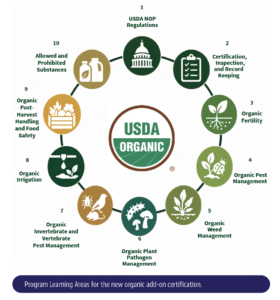
The OSp exam is based directly on ten performance-objective areas spanning organic regulations as well as practical knowledge in key production areas.
1. USDA National Organic Program Regulations.
Advisers will demonstrate knowledge of the USDA National Organic Program structure, relationships among the NOP, organic certifiers, producers, handlers, wholesalers, and retailers, as well as the potential consequences for noncompliance and/or fraud.
2. Certification, Inspection, and Record Keeping.
Advisers will understand land eligibility and transition requirements, Organic System Plans, inspection preparation, audit trails, traceback and mass balance. They will be knowledgeable about practical safeguards against contamination, commingling, fraud and risk in split or parallel operations.
3. Fertility management.
Adviser will understand soil as a living system and the biological underpinnings of nutrient cycling and mineralization of organic fertilizer. Advisers will understand the connections between soil texture, temperature, organic matter, fertilizer application method, and crop rotations that support long-term soil function.
4. Organic integrated pest management.
Advisers will demonstrate knowledge of the prevent-identify-monitor-decide-act-evaluate cycle of organic IPM. They will understand the hierarchy of organic pest management: prevention, sampling plans, crop rotation, resistant varieties, mechanical tactics, biological control, and judicious use of approved materials when other approaches are insufficient.
5. Weed management.
Adviser will demonstrate knowledge about seedbank dynamics, zero-seed-rain, crop-weed life-history relationships and the interaction of irrigation and fertility with weed pressure. Advisers must understand how cultural, physical, biological and approved chemical tactics work, and where their limits lie.
6. Disease management.
Advisers will understand the disease triangle, basic pathogen biology, the importance of resistant and tolerant varieties, sanitation, crop rotation, irrigation and canopy management, suppressive soils, biologicals and allowed materials.
7. Invertebrate and vertebrate pests.
Advisers will demonstrate understanding of pest and beneficial biology, phenology, monitoring, biodiversity, habitat requirements and integrated tactics ranging from exclusion and trapping to augmentative and conservation biological control and approved materials.
8. Irrigation management.
The adviser will have knowledge of optimal irrigation method selection to fit soil, crop, water quality and management limits. They will also understand weather-, soil- and plant-based monitoring, distribution uniformity, salinity and reducing nutrient loss.
9. Postharvest handling and food safety.
The adviser will understand that organic integrity continues after harvest. Certified advisers will demonstrate knowledge of segregation, sanitation, storage, transport, traceability, water management, pathogens and the intersection of organic rules with preventive food-safety programs.
10. Allowed and prohibited substances.
Advisers will understand that an input decision is not resolved by a product label or a generic claim that a material is organic. They must understand the National List, use restrictions, excluded methods, operation-specific approved materials lists and the organic certifier’s final authority on allowed products and their uses.
What the credential signals
Earning the Organic Specialty signals that the holder will take a disciplined approach to providing advice to organic clients. An OSp holder will know to verify field history before calling acreage organic, to examine the full product and use context before recommending an input, to help a grower document a decision and to involve the certifier before a change creates a compliance problem.
That approach benefits both growers and advisers. Growers gain access to advisers better prepared to identify organic-specific tradeoffs, from fertility timing to recirculated wash-water management. Advisers gain a nationwide credential that can distinguish their capabilities in a growing market and create opportunities to take on new responsibilities in crop consulting, retail agronomy, crop protection, soil health, food safety and transition planning.
A practical next step for CCAs
For CCAs who already advise organic farms, work with growers considering transition or see organic clients as part of their future business, the OSp provides an industry-recognized path to demonstrate relevant expertise. Study materials are organized around the performance objectives, and exam questions are based directly on those objectives. The program is designed to evolve as organic production practices and regulatory needs change.
Organic agriculture needs advisers who can see the whole system: soil, crop, pests, water, people, records and markets. The CCA Organic Specialty gives qualified advisers a way to demonstrate that they are prepared to do exactly that.
Learn more
American Society of Agronomy,
CCA Organic Specialty:
https://www.sciencesocieties.org/
certified-crop-adviser/already-certified/organic
Acknowledgments
I would like to acknowledge Dr. Dawn Gibas and Luther Smith of the American Society of Agronomy, Dr. Karl Wyant of Nutrien, and California Certified Organic Farmers, for their support and leadership in creating the specialization. I would also like to thank the many CCAs that contributed to the creation of the specialization.
This work was supported by the USDA Transition to Organic Partnership Program (TOPP), part of the USDA Organic Transition Initiative, administered by the USDA Agricultural Marketing Service (AMS). The contents are solely the responsibility of the author and do not necessarily represent the official views of the USDA.
Publisher’s Take
The Big Picture:
1. The Organic Specialty is for active CCAs
The new OSp credential provides a nationally recognized foundation for advising organic and transitioning operations.
2. Organic compliance is part of crop advising
Advisers need to understand certification, recordkeeping, approved inputs and when a decision requires review by an organic certifier.
3. The credential goes beyond regulations
The 10 learning areas include fertility, IPM, weeds, disease, pests, irrigation, postharvest handling and allowed and prohibited substances.
4. Input recommendations require an extra check
A product label or claim that a material is organic does not determine whether it can be used. Advisers need to consider the National List, use restrictions and the operation’s approved materials.
5. The goal is better decision-making, not instant expertise
The specialty establishes a baseline that helps CCAs identify risks, ask better questions and recognize when additional guidance is needed.
