

In 1994, the California Air Resources Board (CARB) had initially identified “soil NOx” as a significant source of air pollution coming from agriculture in the San Joaquin Valley. Soil NOx includes emissions of nitric oxide and nitrogen dioxide that are emitted from agricultural soils following fertilization. NOx and volatile organic compounds (VOC) react together in the presence of sunlight to form ozone. The San Joaquin Valley is non-attainment for ozone, meaning the valley does not meet the National Ambient Air Quality Standard (NAAQS). In fact, the San Joaquin Valley is among the worst areas for ozone in the country and is considered “extreme non-attainment” for ozone.
Based on the current emissions inventory, NOx emissions play the more pivotal role in ozone formation, so EPA, CARB and the San Joaquin Valley Air Pollution Control District have focused on lowering NOx emissions. Combustion has been identified as the predominant source of NOx emissions, so trucks, vehicles and engines have been the focus of most regulatory efforts to date. However, soil NOx has always been on the radar screen and has received a great deal of attention in the last couple of years.
Early Research on Soil NOx
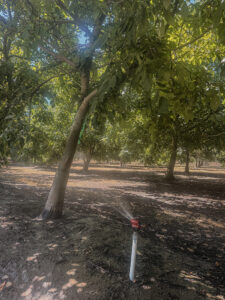
To quantify just how significant these emissions were, CARB contracted with UC Berkeley in 1994 to conduct research and measure soil NOx emissions from various crops in the San Joaquin Valley before, during and after the application of fertilizer.
“The goal is to ensure the science is done right and accurately reflects common industry practice.”
The study used flux chambers placed directly on the soil to measure the emissions at 26 different locations from various crops including cotton, alfalfa, almonds, corn, sugar beets, grapes, irrigated pasture, oranges, peaches and tomatoes. Emissions ranged from 1.0 to 9.1 ng-N cm-2 h-1. While there was some variability in the results, the authors commented “our data clearly suggest that NOx fluxes in the San Joaquin Valley in July and August 1995 were not remarkably high in comparison with the range of values published in the literature.” As a result, CARB did not pursue any actions on regulating soil NOx.1
New Research Reopens the Question
Then in 2018, an article from UC Davis researchers claimed that soil NOx emissions from agriculture are 161,100 metric tons of NOx-N per year, equating to as much as 32% of all NOx emissions in the state. It should be noted these estimates were completely based on models and not on actual emissions measurements.2
This report was met with great skepticism, led by a report published nine months later in the same publication, which claimed that the previously mentioned Almaraz report used an assumed fertilizer input that exceeded reported statewide sales of fertilizer N by 50%.3
Over the next couple of years, one of the co-authors in the Almaraz report, Dr. Ian Faloona, took this issue on personally, even testifying at hearings and workshops of the California Air Resources Board (CARB), commenting that soil NOx emissions are under-reported and need to be regulated. Ultimately, this pressure resulted in the establishment of the Subject Matter Expert Review Panel (SMERP) to review all data and science on soil NOx emissions. After meeting for months, the SMERP issued a final report in May 2025 that concluded “more studies focusing on organic and inorganic N-rich amendments are needed, as well as to investigate the impacts of micro-irrigation and fertigation practices on gaseous N losses.”
Another Look at Soil NOx
As a result, CARB has contracted with UC Irvine and UC Davis to conduct longer-term and more comprehensive measurements on soil NOx throughout 2027. The Western Tree Nut Association has met with CARB and the researchers on the proposed efforts and is currently reviewing the proposed work plan. The goal is to ensure the science is done right and accurately reflects common industry practice.
In the end, one must wonder, if you believe what they say in how much nitrogen gets past the root zone and into the groundwater, and how much comes out of the soil and into the atmosphere, how much nitrogen gets to the plant? Maybe this latest research project will get us that answer. Who knows? One thing we do know: California will never stop looking for ways to regulate us.
References
1. Matson, Pamela, and Mary Firestone. “Agricultural Systems in the San Joaquin Valley: Development of Emissions Estimates for Nitrogen Oxides.” University of California, Berkeley. Contract No. 94-732. January 1997.
2. Almaraz, Maya, et al. “Agriculture Is a Major Source of NOx Pollution in California.” Science Advances. Jan. 31, 2018.
3. Maaz, Tai McClellan, et al. “Inconsistencies Undermine the Conclusion That Agriculture Is a Dominant Source of NOx in California.” Science Advances. Sept. 12, 2018.
