

It’s no secret that growers and advisors increasingly require tools that can identify nutritional and fertility problems before visible symptoms appear. No one has time for yield drag in today’s agriculture. Modern crop varieties grow faster, produce higher yields, and operate within narrower nutritional margins than previous generations. As a result, annual, general or infrequent testing methods often fail to capture the rapidly changing nutrient dynamics.
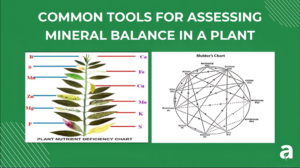
There are many technologies available today to assess plant nutrition, and each technology contributes valuable information. Petiole testing, chlorophyll meters, remote sensing, NDVI imagery, X-ray fluorescence systems and other diagnostic tools, such as qPCR or genomic sequencing, all contribute valuable information. Modern laboratories are now capable of analyzing dozens of nutrients, metabolites and stress indicators simultaneously.
Traditional tissue analysis has been the gold standard for many years for long-term nutrient monitoring alongside annual soil assessment. However, tissue analysis reflects accumulated nutrient content rather than current physiological activity, which puts the grower at a disadvantage relative to the stresses of today’s agriculture, especially if laboratory turnaround times are slow.
Leaf sap analysis measures nutrients actively moving through the plant, allowing growers to identify deficiencies, excesses and metabolic imbalances before visual symptoms develop.
Remote sensing technologies, such as satellite imagery, drone-based NDVI and handheld spectral instruments, provide large-scale observations of crop performance. These systems can identify variability across fields but often cannot determine the specific nutritional cause of stress. While soil testing can offer general guidance, petiole testing offers insight into mobile nutrients but generally evaluates a limited number of analytes.
Leaf sap analysis addresses a number of key challenges missed by other methods, adds confirmation to remote sensing tools, and provides deeper insight into validating nutrient uptake from soil and tissue tests. It does this by providing a direct measurement of nutrients and metabolites actively circulating within plant tissues at the time of sampling.
With the analysis of more than 20 elements obtained from fresh plant extracts, growers gain insight into nutrient movement, nutrient availability, stress responses and, ultimately, metabolic activity occurring at the time of sampling. This ability to observe active plant physiology allows for optimization, comparison with other varieties, or taking corrective action before yield or quality losses become severe.
The Shift Toward Precision Crop Nutrition: Beyond Supplementing Deficiencies
More advisors are now recognizing that crop performance truly depends on nutrient balance, nutrient timing, nutrient mobility, sugar production, stress tolerance, biological activity and nutrient interactions. Through leaf sap analysis, growers and advisors can evaluate:
• Nutrient response from applications
• Nutrient sufficiency and deficiency trends
• Nutrient excesses and toxicities
• Sugar production and energy allocation
• Nitrogen metabolism
• Stress responses
• Fertilizer efficiency
• Foliar application performance
• Biostimulant effectiveness
Sampling Protocols and Methods
With leaf sap analysis, growers monitor crop physiology continuously throughout the growing season by sampling the plant at key growing intervals. Aligning the laboratory’s need for fresh plant extracts with field sampling protocols involves small shifts in sampling procedures.
• Sample bags are moisture-sealed to prevent dehydration of leaves.
• Plants are sampled in the morning.
• Plants are sampled at multiple, specific locations on the plant.
• Typical pairings are new leaf/old leaf and spur growth/basal growth.
• Crop varieties (Chardonnay/Merlot) are sampled separately.
• Plants are sampled multiple times throughout the season at key life-cycle stages.
• Samples should reach the laboratory within two days.
• Samples are processed within 24 to 48 hours.
• Results are received as rapidly as possible.
• Corrective action should be taken as quickly as possible based on the data generated.
Diagnosing Deficiencies and Excesses by Comparing New and Old Leaves
After sampling more than one part of the plant for leaf sap analysis, the results are compared on a single report. Nutrient mobility, as discussed in textbooks, is now presented through real-time observation. Data comparisons between new and old leaves provide a new source of information and additional opportunities for crop advisors.
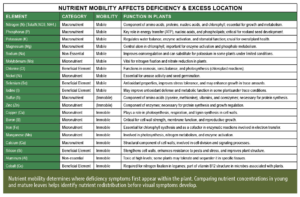
Nutrient gradients that previously appeared only as visual discoloration during field scouting are expressed in parts per million. Mobile nutrients, such as nitrogen, phosphorus, potassium and magnesium, move from older tissues into newer growth. As a result, deficiencies often appear first in older leaves.
On a leaf sap analysis report, growers can see whether the nitrate level, or another mobile nutrient such as potassium or magnesium, in the new leaf is greater than or less than the level in the old leaf, rather than relying solely on faded green tissue in lower leaves. This allows growers to identify deficiencies, sufficiency or excesses quantitatively rather than relying on leaf appearance.
Immobile nutrients, such as calcium, iron, manganese, zinc, boron and copper, cannot be readily relocated within the plant. Deficiencies therefore appear first in developing tissues. Micronutrient deficiencies of immobile nutrients that eventually appear as chlorosis in new leaves are reflected in leaf sap analysis as lower values, measured in parts per million, in new leaves than in old leaves long before discoloration has an opportunity to reduce quality.
This helps agronomists diagnose deficiencies, distinguish among them, such as nitrogen versus potassium or iron versus manganese, and match field observations with confirmed laboratory data, allowing identification of:
• Early-stage deficiencies
• Hidden hunger
• Nutrient antagonisms
• Toxicities
• Nutrient redistribution patterns
• Chronic imbalances
Using this information to support targeted corrective actions that improve nutrient efficiency while reducing unnecessary fertilizer applications can offer significant improvements in crop steering.
A crop may contain abundant nitrogen while simultaneously exhibiting poor nitrogen utilization. Understanding that difference can improve fertilizer decisions and nutrient-use efficiency.
Nitrogen Forms Reveal Metabolic Efficiency
Leaf sap analysis enables measurement of multiple nitrogen forms, including:
• Total nitrogen
• Nitrate nitrogen (NO₃-)
• Ammonium nitrogen (NH₄+)
• Free amino nitrogen
These measurements reveal how efficiently plants convert inorganic nitrogen into amino acids and proteins. A crop may contain abundant nitrogen while simultaneously exhibiting poor nitrogen utilization. This type of diagnostic becomes routine using leaf sap analysis, highlighting the difference between nitrogen availability and nitrogen metabolism.
This information guides more precise nitrogen management decisions, including fertilizer source, placement and application method, as well as answering the questions, “Should we apply?” and “How much should we apply?”
The Importance of pH and Electrical Conductivity
During leaf sap analysis, additional metrics that are not common in tissue analyses are assessed, including sap pH and electrical conductivity (EC), which provide valuable information regarding nutrient balance and plant health.
Sap pH can indicate differences in nutrient availability and uptake patterns. Low pH conditions may suggest excessive cation uptake, while elevated pH levels may signal anion dominance and confirm specific nutrient deficiencies.
Electrical conductivity reflects total dissolved ion concentration within plant tissue. Similar to soil EC readings, elevated EC levels may indicate excessive fertilization, salinity stress or osmotic challenges. Low EC values often suggest insufficient nutrient uptake, waterlogged conditions or reduced metabolic activity.
Tracking these measurements over time allows growers to optimize fertigation programs and identify emerging problems before they affect yield.

Sugars: The Currency of Plant Productivity
Sugar production represents a direct measure of photosynthetic performance and plant energy status. Comparing sugar concentrations between young and mature leaves provides insight into energy production, transport and allocation throughout the plant.
Healthy crops typically exhibit balanced sugar movement from mature leaves to actively growing tissues. Imbalances may indicate nutrient deficiencies, environmental stress, disease pressure or disruptions in metabolic activity. Monitoring sugar dynamics allows growers to evaluate whether plants are prioritizing growth, reproduction, defense or survival.
Integrating Leaf Sap Analysis with Precision Agriculture
The most successful nutrient management programs integrate multiple information sources, including:
• Soil testing
• Leaf analysis
• Irrigation water analysis
• Weather data
• Remote sensing
• Yield maps
• Historical field records
While satellite and drone imagery excel at identifying where variability exists across a field, soil testing helps explain nutrient inventories and fertility reserves.
Leaf sap analysis provides insight into how those nutrients are functioning inside the plant.
Together, these tools create a more complete understanding of crop performance.
For example, a drone image may identify a low-vigor area. Soil testing may reveal an adequate fertility level, but leaf sap analysis may identify manganese deficiency, aluminum toxicity, poor nitrogen assimilation or reduced sugar production as the actual cause of the observed stress.
This integrated approach allows growers to move beyond symptom identification toward root-cause analysis.
From Reactive Agriculture to Predictive Agriculture
Generally speaking, agronomists rely upon mixed signals to make decisions, including insect and disease pressure, visible chlorosis, necrosis, poor vigor, reduced fruit set, or reduced fruit, nut or grain fill, to trigger corrective actions after damage has already begun.
But what if plants have already provided the signals for those symptoms weeks earlier in their leaves?
Changes in nutrient gradients between young and mature leaves frequently appear before visual symptoms develop. Changes in sugar levels, nitrogen forms, conductivity and stress biomarkers can reveal emerging problems days or weeks before yield losses become irreversible.
Weather stations, satellite imagery, drones, irrigation systems and soil sensors can be complemented by leaf sap analysis by providing information directly from inside the plant itself, the ultimate integrator of soil, climate, biology and management conditions. Analyzing leaf sap essentially transforms the crop itself into a biological sensor, providing an ongoing platform for agronomists to apply basic agronomic principles rapidly.
This change from reactive to predictive management, combined with crop steering, represents one of the most important advances in crop diagnostics over the last two decades.
Why Nutrient Management Matters More Than Ever
By combining real-time plant diagnostics with data science, precision fertility and continuous monitoring, growers using leaf sap analysis can move closer to the ultimate goal of modern agriculture: maximizing yield, quality, profitability and resource efficiency simultaneously.
Research consistently demonstrates that nutrient-use efficiency remains a major global challenge. Modern cropping systems recover only about 35% to 40% of applied nitrogen fertilizer on average, while phosphorus recovery efficiencies are often below 20%.
In practical terms, a substantial portion of applied fertilizer never becomes plant biomass and instead remains tied up in the soil or is lost through leaching, volatilization, runoff or biological transformations.
These inefficiencies create both economic and agronomic challenges for growers, consultants and consumers. The question is no longer simply whether nutrients are present in the soil. The more important question is whether nutrients are being absorbed, translocated, metabolized and converted into yield and quality.
The question is no longer simply whether nutrients are present in the soil. The more important question is whether those nutrients are being absorbed, translocated, metabolized and converted into yield and quality.
The Cost of Hidden Hunger
Most agronomists are familiar with the concept of “hidden hunger.” A crop may appear healthy while simultaneously experiencing yield loss, quality reduction, diminished stress tolerance or lower nutrient density.
This challenge is becoming increasingly common in intensive production systems where repeated cropping, irrigation, high-yield genetics and large nutrient exports place greater pressure on soil fertility programs. Even fields receiving substantial NPK applications may experience micronutrient shortages
or nutrient antagonisms that limit crop performance. Because hidden hunger often develops before visual symptoms appear, traditional scouting methods may identify problems only after economic damage has already occurred.
The consequences extend beyond yield alone. Nutrient imbalances can influence:
• Fruit size and uniformity
• Protein accumulation
• Sugar production
• Shelf life
• Disease susceptibility
• Drought tolerance
• Market grade and premiums
The Economics of Overapplication
Most crop production decisions are made under less than full certainty. Dozens of variables and seasonal assumptions influence reactionary input positioning. Under these conditions, growers frequently choose to apply additional fertilizer as insurance against potential deficiencies because they lack real-time information about plant nutritional status. However, this practice often results in missed opportunities for fertilizer optimization.
While underapplication can reduce yield potential and crop quality, overapplication can create even greater problems, including increased costs, nutrient imbalances, salt stress, excessive vegetative growth, delayed maturity and environmental losses.
In many high-value crops, preventing even small reductions in yield or quality can generate returns that substantially exceed the cost of diagnostic testing and supplemental applications.
Publisher’s Take
The Big Picture: What to do Next
1. Add in-season plant monitoring to your nutrient management program
Don’t rely solely on preseason soil tests or annual tissue sampling. Combining leaf sap analysis with existing diagnostics can provide earlier insight into nutrient imbalances and crop stress.
2. Sample both young and mature leaves
Comparing nutrient concentrations between new and old leaves can reveal nutrient mobility, redistribution patterns and hidden deficiencies before symptoms appear in the field.
3. Use leaf sap analysis to evaluate fertilizer performance, not just fertility levels
Measure how efficiently nutrients are being absorbed and metabolized so you can fine-tune fertilizer timing, rates and application methods during the season.
4. Combine multiple diagnostic tools before making nutrient decisions
Use leaf sap analysis alongside soil tests, irrigation water analysis, remote sensing and field observations to identify the cause of crop stress rather than treating symptoms alone.
5. Look beyond yield when evaluating nutrient management
Monitor indicators such as sugar production, nutrient balance and nitrogen metabolism to improve crop quality, nutrient-use efficiency and overall return on fertilizer investments.
