

Why buy fertilizer when you have it fresh and homegrown?
Ordering imported synthetic fertilizer yields sticker shock for a lot of farmers lately. In recent years, the global fertilizer market has been volatile due to various trade disruptions. A mid-June report tracked the urea N fertilizer price at $731/ton, down from a reeling $850/ton a month prior, still approximately $100/ton higher than the five-year average. Texas A&M reported earlier this year that US phosphorus fertilizer prices have soared more than 28% the last six years due to trade policies. It is no wonder there has been a resurgent interest in use of locally sourced manure as a fertilizer for crops. Manure is abundant and rich in many essential plant micro- and macronutrients. One caveat with manure fertilizer remains: aside from commercially produced compost, manure doesn’t carry a guaranteed analysis label, so it needs regular testing to support prescribed nutrient applications to crop fields.
Sampling and analysis of manure for its fertilizer value is critical to accurately credit a crop nutrient budget and has added environmental benefits. Measuring manure nutrient content prior to application is necessary to understand its fertilizer value. Incorporating tested value of manure nutrients into a crop nutrient budget is essential to improve nutrient use efficiency within a field and across the farm. Prudent use of manure as a fertilizer can reduce demand for import and overuse of synthetic fertilizers, a known culprit of greenhouse gas emissions and a pollutant source of waterways and aquifers. Sampling is essential since manure nutrients vary between farms and within a farm. As manure is handled on a dairy facility, and as seasonal changes influence animal housing and bedding practices, manure nutrient composition changes. Additionally, nutrient content of irrigation water blended with process wastewater from a dairy lagoon can change significantly during the course of a single irrigation.
Prudent use of manure as a fertilizer can reduce demand for import and overuse of synthetic fertilizers.
Changes in cattle management and treatment of manure types can also influence nutrient composition. Manure collected in corrals can be stockpiled, composted, and/or easily shipped off farm for sale. In free-stall dairies with concrete flush lanes, summer versus winter can mean the difference between more dilute versus more concentrated manure in storage lagoons. Add an anaerobic digester to the waste treatment system and monitor the organic to mineral nitrogen ratio shift between influent and effluent. Vacuum or scrape the lane manure and now you have a pre-lagoon slurry to manage. Each of these alternative management practices necessitates greater testing of manure streams prior to land application. As seasons and management change, continued manure sampling and analysis for nutrients is necessary before including the manure sources in a crop nutrient budget.
Manure can be a valuable fertilizer choice, but it must be tested and utilized effectively to benefit the farm.
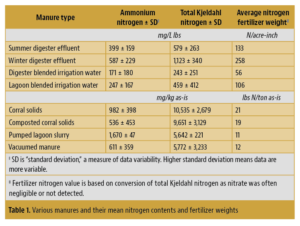
In several research projects in California, we’ve identified significant variability of manure nutrient content. Table 1 compiles nutrient analysis results from select research projects. The emphasis herein is on nitrogen form and content because of high local concern for groundwater quality. The table also shows lab test values of nitrogen for the manure converted to units meaningful for land applications as fertilizer. An important difference exists between ammonium and total Kjeldahl nitrogen. Ammonium nitrogen is immediately plant available, and total Kjeldahl nitrogen – sum of organic and ammonium nitrogen – has the additional organic fraction of nitrogen which is not immediately plant available. Organic nitrogen needs to be mineralized – decomposed to ammonium by soil microorganisms – before it becomes plant available.
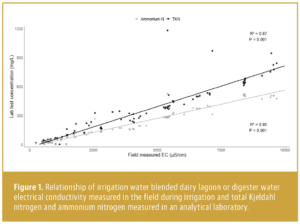
In a California Dairy Research Foundation funded experiment testing hand-held meters for their ability to predict nitrogen concentration in irrigation water blended with lagoon water, we’ve identified interesting trends. Figure 1 shows a strong relationship between electrical conductivity measured in the field and lab tested nitrogen. These preliminary results indicate that electrical conductivity, a common water quality measurement indicating salinity level, may predict nitrogen content of irrigation water blended with lagoon water with reasonable accuracy. This would be a vast improvement over current practices for estimating nitrogen application via blended lagoon water irrigation. Research is ongoing and more testing is needed to best understand how practical this relationship is.
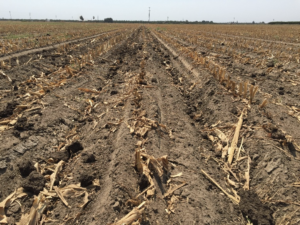
In addition to knowing nutrient composition, application of manure is restricted by its physical form. That is, solid manure applications are often limited to time between crops because of heavy equipment used to spread the manure, while liquid manure lends itself to applications between and within crops since it can be applied with irrigation water. That said, the physical and chemical properties of manure are heterogeneous – not uniform – and thus make uniform application difficult compared to commercial fertilizer applications. For example, most liquid manure applications in California rely on irrigation water delivery, and these systems can have flaws in design and use if not properly managed. Figure 2 shows the visual difference in water quality between two side-by-side irrigation valves running simultaneously in the same field inadvertently delivering very different nutrient concentrations to adjacent sections of the field. In another example, the moisture content of stockpiled corral manure often makes it cloddy and subject to uneven dispersal during land application. Figure 3 shows manure solids after a broadcast application to corn stubble prior to planting a small grain cereal forage crop. In a minimum tillage system, the nutrients in these clods would be very unevenly distributed to the following crop. Although incorporating these clods with soil cultivation to prepare a seedbed will improve the nutrient distribution uniformity as well as minimize nitrogen losses through ammonia volatilization, the nutrients will not be distributed as uniformly as broadcasted synthetic fertilizer pellets, for example. One of the forgotten values of manure is carbon. Addition of carbon to soil should improve porosity, water holding capacity and tilth. Even though nutrient composition of manure isn’t homogeneous, it can be managed to be applied more uniformly and to reduce nitrogen loss.
For the reasons above and countless others – e.g. crop type, yield and feed quality targets, site specific soil conditions, local regulations, potential carbon credits, etc. – it is paramount for the crop consultant, such as a Certified Crop Adviser, to work closely with each client to understand and work within the farm constraints and meet each producer’s unique goals. Manure can be a valuable fertilizer choice but must be tested and utilized effectively to benefit the farm.
Publisher’s Take
The Big Picture: What to do Next
1. Start with your goals first
The tool works best when growers clearly prioritize goals such as nitrogen fixation, erosion control, weed suppression, or pollinator habitat.
2. Location matters
Recommendations are customized using local climate, frost dates, precipitation and soil conditions to improve the likelihood of successful establishment
3. Do not overfilter recommendations
Highly ranked species may still offer benefits even if they are not a perfect fit in every category.
4. Pay attention to planting windows
The tool overlays cover crop establishment timing with cash crop schedules to help avoid management conflicts.
5. Review management considerations before planting
Species profiles include seeding rates, termination methods, pest concerns, grazing limitations and residue management challenges that can affect field performance.

Nick Clark | University of CA, Agriculture and Natural Resources
Rubia Branco Lopes | University of CA, Agriculture and Natural Resources
Jennifer Heguy | University of CA, Agriculture and Natural Resources
Joyce Pexton | University of CA, Davis, Dept. of Animal Science