

Bird damage in many high-value fruit and nut crops presents a persistent management challenge. High bird pressure at harvest can result in yield losses or unmarketable fruit.
At a drone applications workshop held at the UC Kearney Research Center, UCCE Farm Advisor Raymond Mireles outlined his work over the past year seeking a flexible, responsive bird deterrence strategy.
Crop damage varies by bird species, flock size, location and season. Blueberries and pistachios can be hit hard when birds become habituated to feeding on these crops.
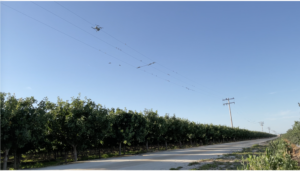
Several bird species, including scrub-jays, magpies, sparrows, house finches, crows and starlings, may cause substantial damage by feeding on ripening fruit or developing nuts. In general, scrub-jays and magpies feed in smaller numbers. However, they can congregate in larger flocks when orchards are adjacent to perennial, thick vegetation. Crows and starlings typically fly in larger flocks. Bird species that congregate in large flocks are more difficult to control.
Current deterrents, Mireles said, can be expensive or lose their effectiveness over time. Two of the most-used deterrents are netting and auditory scare devices. Netting, he noted, has high labor costs, while birds can become habituated to auditory devices. Other deterrents in use include predator nest boxes, lethal shooting and visual scare devices, which were all less effective than netting or auditory scare devices.
With funding from the Blueberry Commission, Mireles has been studying the use of drones to haze bird flocks from blueberries. He said research into the use of Unmanned Aircraft Systems to haze birds began in 2018 with predatory-shaped drones that had increased flight distances. Subsequent studies found that hazing with drones could reduce crop damage. With larger drones and sustained hazing activity, most birds moved from fields. Drone size, speed and predatory cues influenced responses, and longer hazing delayed bird return.
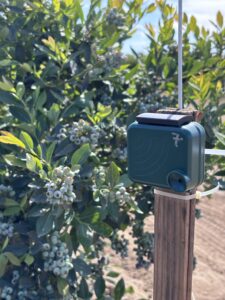
Mireles’ study this year focused on identifying frequently detected bird species causing damage in blueberries, determining the time of day the birds are most active in the crop and testing the effectiveness of drone-based hazing.
Autonomous audio recorders were used at three locations in Delano and Kingsburg where blueberries are produced. Mireles said these recordings can identify bird species in the field and determine what time of day they are most active. The monitoring overlapped ripening, harvest and postharvest conditions from April 14 to June 16.
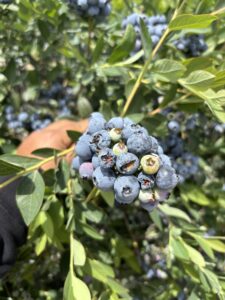
Birds identified were placed in three categories: berry feeders, opportunistic feeders and insectivores. Berry feeders included European starlings, house finches, cedar waxwings and American robins, with cedar waxwings and house finches the most frequently detected.
Morning detections of bird activity were significantly higher than evening detections at all locations and peaked from 7 to 8 a.m.
Hazing Effectiveness
Mireles also tested the effectiveness of drone hazing to deter birds in blueberries. A DJI Mavic model was used for a total of 27 drone flight observations, with bird responses noted as no response, alert only, flush and short movement, or abandonment of the area.
Fifteen encounters resulted in birds flushing and moving a short distance. Only eight encounters resulted in abandonment of the area. Mireles observed that cedar waxwings were frequently displaced by drone flights, while house finches often required a closer approach by the drone before moving.
This first year of the study established the feasibility of using drones to deter birds, Mireles said. Displacement occurred in 85% of drone encounters, but only 30% resulted in apparent departure from the field. Responses were also species-specific, with cedar waxwings more readily displaced.
Research in 2027, Mireles said, will study which drone operating conditions produce reliable and sustained displacement of key blueberry-feeding bird species. He will also evaluate crop protection and the economic feasibility of the refined drone-hazing protocol. In the future, workshop speakers said AI-enabled autonomous drones could be employed to haze birds.