

Understanding Insecticide Performance Characteristics Is Critical to Making Biological Insecticides Work in Modern Pest Management Systems
Understanding Biopesticide Performance: Why Biological Insecticides Require a Different Management Mindset
Since the 1940s, insect pest management has relied on chemistries that were broad-spectrum, fast-acting, long-lasting and relatively inexpensive. These products worked well under a wide range of conditions and often compensated for imperfect timing or application (Casida and Quistad, 1998; Sparks and Nauen, 2015).
Biological insecticides operate differently.
That difference means they must be used with greater precision to be effective. Disappointing results with biologicals often occur because they are expected to behave like conventional synthetic insecticides.
Two concepts help explain this shift: the insecticide triangle and performance characteristics.
The Insecticide Triangle
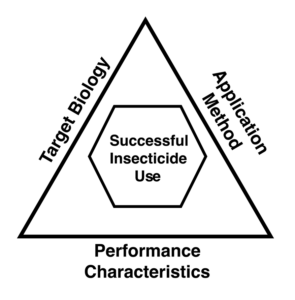
Effective pest management sits at the intersection of three factors: target biology, application method and pesticide performance characteristics (Fig. 1). The product must be delivered effectively to a susceptible target under conditions that maximize target contact with the material.
With conventional insecticides, strong performance characteristics often carried the system. Products provided broad-spectrum activity, rapid contact activity and long residual control that could be measured in weeks. As a result, single chemistries could provide satisfactory control of multiple pests with less consideration of spray coverage, application timing and pest biology.
Biological insecticides differ radically in their performance characteristics, making alignment among pest biology, application technology and product performance critically important. Failure to understand and optimize these three sides of the triangle will nearly always lead to reduced performance.
What Are Performance Characteristics?
Performance characteristics describe how an insecticide behaves in the field and determine how to use it effectively.
A simple way to frame this concept is to think about how we evaluate equipment or tools. For example, while the primary function of a hammer is to drive and pull nails, it can also be used to cut drywall or drive drywall screws, albeit with poor results. In contrast, saws and screwdrivers perform these tasks far better but are not well suited to driving and pulling nails. A similar logic applies to insecticides.
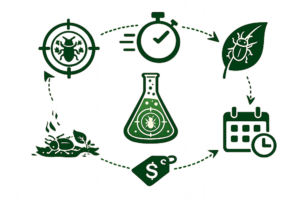
One model of insecticide performance characteristics includes (Fig. 2):
1. Spectrum of activity
2. Speed of action
3. Delivery pathway
4. Residual activity
5. Cost
Whether actively considered or assumed, these traits determine how a product fits into a pest management program and what is required to make it successful.
What Conventional Insecticides Trained Us to Expect
The dominant insecticides of the late 20th century, for example chlorinated hydrocarbons, organophosphates, carbamates, pyrethroids and neonicotinoids, shared several key performance characteristics:
1. Broad-spectrum activity: One product controls a broad range of pests.
2. Rapid knockdown at low doses, often through nerve toxicity.
3. Secondary contact activity: Pests only need to touch a treated surface.
4. Residual control lasting two or more weeks, reducing the need for reapplication.
5. Low cost through highly scalable petrochemical-based production technology.
These characteristics made pest control with these products exceptionally forgiving. Products could be applied with less precision and still deliver acceptable results. To continue the previous tool analogy, traditional insecticides had the characteristics of a multitool, with a single product capable of satisfying a broad range of pest management tasks (Casida and Durkin, 2013).
Those expectations still influence how biological insecticides are used today. We have been trained to expect repeatable, immediate results under a broad range of circumstances.
How Bioinsecticides Differ
Biological and reduced-risk insecticides generally have a different performance profile:
• Narrower spectrum: They may control only a single pest.
• Slower activity: Most work by disrupting digestion, behavior, hormones or the cuticle.
• Commonly lack secondary contact activity: The target pest must ingest the product or be sprayed directly.
• Shorter residual activity: Products may require precise timing and/or reapplication.
• Higher cost per application: Products are often derived from complex biological systems and require higher application rates.
Achieving desired results with these typically less forgiving products requires considerably more attention to understanding which pests are vulnerable, along with careful timing and application. We must understand the specific “job” we are asking the tool to perform.
Why Delivery Pathway Matters
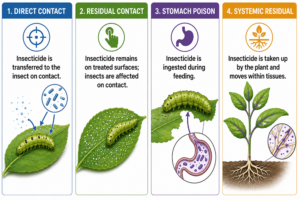
One of the most important differences between biological and conventional insecticides is how they enter the insect (Fig. 3).
Conventional insecticides often rely on secondary contact, where pests only need to move across treated surfaces. As a result, mobile insects are likely to pick up a lethal dose even under low spray coverage. In contrast, many biological insecticides rely on ingestion or direct contact. In the former case, insects receive a lethal dose only if they consume a treated plant part. In the latter, they must be sprayed directly.
This has practical implications. A stomach poison such as Bacillus thuringiensis (Bt) (e.g., Dipel or Xentari) requires thorough coverage of feeding surfaces and works best on smaller larvae (Schnepf et al., 1998). A contact material, such as an oil or soap, must physically reach the pest to suffocate it or disrupt its cuticle (skin). As a result, the performance of these products depends on excellent spray coverage. This also limits efficacy against piercing-sucking pests (e.g., true bugs), which may not ingest sufficient residues compared to chewing insects and are often highly mobile.
Categories of Bioinsecticides
The majority of registered bioinsecticides used in specialty crops fall into two groups: microbial and biochemical.
Microbial insecticides include fungi, bacteria, viruses and nematodes that infect insects. The U.S. Environmental Protection Agency (EPA) does not register nematodes because they are considered biological control organisms. However, their application and use are similar to other soil drenches.
Biochemical insecticides include plant extracts, microbial metabolites, oils, soaps and pheromones.
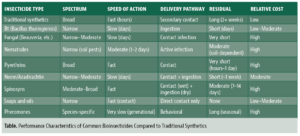
Each group has distinct performance characteristics that determine where and how it fits into pest management programs (Table 1) (Lacey et al., 2015; Mordue and Nisbet, 2000; Schnepf et al., 1998; Sparks et al., 2001).
A Shift Toward System-Based Management
Successful use of biological insecticides requires a shift from a product substitution mindset to one of system design that emphasizes pest prevention rather than responding to pest outbreaks (Kogan, 1998; Ehler, 2006).
The “system” includes:
• Healthy soils and a robust crop fertility program to promote innate and induced plant defenses.
• Crop rotation to minimize specialist pest buildup over time.
• Aggressive crop sanitation, wherever possible.
• Robust scouting and monitoring programs.
• Understanding pest phenology and targeting vulnerable life stages.
• Matching products to appropriate delivery systems.
• Maximizing spray coverage through sprayer calibration and the addition of spreader-stickers.
• Adjusting expectations regarding speed of action and residual activity.
• Conserving beneficial insects by providing year-round habitat and/or augmentative releases.
A key advantage of narrower-spectrum products is that they can preserve natural enemies, allowing biological control to contribute more to pest suppression, especially for secondary pests (Gurr et al., 2017; Van Lenteren, 2012).
The Bottom Line
Biological insecticides are not direct replacements for conventional chemistries. They are different tools with different performance characteristics.
When pest biology, application method and product performance are aligned, biological insecticides can perform very well. When they are not, even effective products may fail.
For crop advisors, the key is not just choosing the right product. It is understanding how that product works and building the system around it.
Common Causes of Bioinsecticide Failure
• Expecting rapid knockdown: Many biologicals act slowly. Judging performance too soon can lead to unnecessary reapplications or abandonment of effective tools.
• Poor spray coverage: Products that rely on ingestion or direct contact require thorough coverage. Inadequate spray distribution is one of the most common causes of failure.
• Mismatch with pest biology: Applying a product at the wrong life stage or targeting pests that are not susceptible to its mode of action.
• Ignoring delivery pathway: Stomach poisons will not perform well on piercing-sucking pests. Contact materials will fail if they do not reach the target.
• Environmental conditions: Many biologicals are sensitive to UV light, temperature and humidity. Bright, hot, dry conditions can significantly reduce performance and residual activity (Lacey et al., 2015).
• Using biologicals as rescue treatments: Some products, especially pheromones and insect growth regulators, are preventive tools. Applying them after populations are established will often lead to disappointing results.
• Inadequate integration: Biologicals work best as part of a system and rarely provide a stand-alone solution.
Checklist: Improving Bioinsecticide Performance in the Field
Before Application
✔️ Correctly identify the target pest.
✔️ Understand pest phenology and vulnerable life stages.
✔️ Confirm the product’s mode of action and delivery pathway are compatible with the target pest.
✔️ Determine whether the product is preventive or curative.
✔️ Check environmental conditions (e.g., temperature, humidity and UV exposure).
Spray Planning
✔️ Buffer the spray tank to the manufacturer’s recommended pH.
✔️ Match spray coverage to the product’s requirements and verify coverage during sprayer calibration.
✔️ Add the manufacturer’s recommended spreader-sticker to the spray tank.
✔️ Increase coverage for ingestion-based products such as Bt.
✔️ Ensure direct contact for soaps, oils and fungal products.
✔️ Consider canopy penetration and droplet distribution.
✔️ Avoid application timing that accelerates UV degradation or heat degradation.
Resistance and Program Design (IRAC 2024)
✔️ Rotate modes of action where required.
✔️ Avoid repeated back-to-back applications of the same mode of action.
✔️ Integrate biological control whenever possible.
✔️ Use thresholds appropriate for slower-acting products. Typically, this means lower treatment thresholds.
✔️ Incorporate biologicals into a season-long management strategy.
After Application
✔️ Evaluate control based on the product’s expected speed of action.
✔️ Monitor surviving pest populations and beneficial insects.
✔️ Adjust coverage, timing or targeting before assuming product failure.
✔️ Record environmental conditions and application details to improve future decisions.
Acknowledgments
The authors thank the Grimm Family Center for Organic Production and Research for supporting the development of this article. This article was developed from an EcoFarm Conference presentation delivered by the authors during a 2025 preconference session. ChatGPT was used for copy editing, formatting and the development of figures.
Publisher’s Take
The Big Picture: What to do Next
1. Match the product to the pest and its life stage.
Before selecting a bioinsecticide, confirm the target pest is susceptible to the product’s mode of action and apply it when the most vulnerable life stage is present.
2. Prioritize spray coverage.
Many bioinsecticides require ingestion or direct contact to be effective. Calibrate sprayers, optimize canopy penetration and use adjuvants when recommended on the product label to maximize coverage.
3. Adjust your expectations for performance.
Unlike many conventional insecticides, biologicals often act more slowly and may have shorter residual activity. Evaluate performance based on the product’s expected mode and speed of action rather than immediate knockdown.
4. Incorporate bioinsecticides into an integrated pest management (IPM) program.
Use biological insecticides as part of a season-long strategy that includes scouting, monitoring, beneficial insect conservation and resistance management rather than as stand-alone rescue treatments.
5. Let pest biology drive application timing.
Successful biological control depends on understanding pest development, environmental conditions and product performance characteristics. Time applications to maximize efficacy instead of relying on broad application windows.

Dr. Matthew J. Grieshop | Director, Grimm Family Center for Organic Production and Research, Cal Poly San Luis Obispo