

Background
4R nutrient stewardship (right rate, time, source and placement) is central to nitrogen (N) management, but how to optimize it in organic systems remains unclear. Unlike synthetic fertilizers, which supply plant-available nitrate and ammonium immediately, organic N must be mineralized by soil microorganisms before becoming available to crops (Stanford and Smith 1972). This process depends on environmental and soil conditions, including oxygen, moisture, temperature, substrate availability and fertilizer characteristics (Lazicki et al. 2020, Geisseler et al. 2021). As these factors shift across sites and seasons, matching N release with crop demand is a continuing challenge in organic production.
Organic fertilizers are applied either by broadcasting across the soil surface or by placing them in concentrated bands, such as side-dress or split applications. At the same per-acre rate, banding creates higher fertilizer concentrations in a smaller soil area. This delivers more N per unit soil but limits the number of microbes that can access and mineralize it. Broadcasting spreads fertilizer across a larger soil volume, increasing microbial contact but at lower concentrations. Timing (split vs. single applications) also determines how much N is available to microbes at once. Because microbial activity rises with fertilizer availability but eventually levels off, higher concentrations or large single applications may not proportionally increase mineralization.
Trade-offs between substrate availability and microbial capacity for decomposition highlight the need to reevaluate 4R nutrient stewardship in organic systems, where practices such as banding and split application may not function as they do in conventional production. Here, we investigate how fertilizer placement and application timing influence nitrogen availability from organic fertilizer in a laboratory simulation.
Laboratory Incubation Study
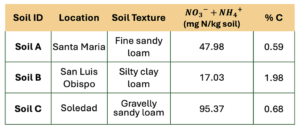
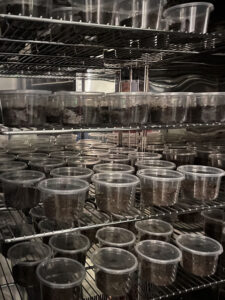
We simulated how fertilizer placement and timing affect N availability from a pelleted organic fertilizer in three 12-week laboratory incubation experiments using soils from organically managed vegetable fields on California’s Central Coast (Table 1). Representative soil samples at each site were gathered from the top 12 inches, avoiding recently fertilized areas. Soils were sieved at 8 mm, homogenized and air-dried. For each experimental unit, 250 g soil was placed in 16-ounce containers and wetted to 60% water-holding capacity (WHC). Lids pierced with small holes were placed on the containers to slow evaporation while keeping soils well-aerated, and water was added weekly to maintain 60% WHC and compensate for evaporative loss.
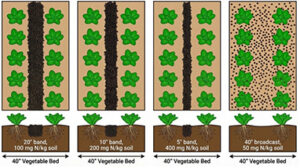
A pelleted 8-5-1 organic fertilizer (meat and bone meal, poultry manure, feather meal and sulfate of potash) was ground for uniform application and watered in to simulate incorporation. After a 10-day pre-incubation to restore microbial activity, soils were incubated at 20 degrees Celsius for 84 days. Fertilizer was applied in a single or two split applications at concentrations ranging from 50-400 mg N/kg soil. The lower rate represented broadcast applications, while higher rates simulated banded applications ranging from 5-20 inches (Fig. 1). Split-application treatments received 50% of the total fertilizer N at the start of the incubation and 50% at the midpoint. Soil samples were collected periodically over 84 days and analyzed for ammonium and nitrate. The percentage of N mineralized was calculated as the difference in N concentration between fertilized treatments and an unamended control, divided by total N applied.
Key Findings
Banding Increases Nitrogen Concentration but Reduces Efficiency
Higher fertilizer concentrations, simulating banded applications, increased mineral nitrogen (N) levels in soil but reduced overall fertilizer efficiency. In conventional systems, banded applications often improve fertilizer N uptake by placing nutrients directly in the root zone, where plants can access it (Nkebiwe et al. 2016). In organic systems, however, these placement strategies do not consistently produce the same results. When soil N is already sufficient, placing fertilizer in concentrated bands may not improve N efficiency compared to broadcasting, since higher localized concentrations do not necessarily increase microbial mineralization (Kallela 2006).
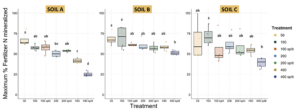
In this study, the percent of fertilizer N mineralized in simulated banded applications was lower than in treatments simulating broadcast application, in both single and split applications (Fig. 3). This pattern was consistent across all three soils and aligns with previous work showing that microbial processing of organic nitrogen can become limited at high N concentrations (Geisseler et al. 2010, Cassity-Duffey et al. 2020), resulting in lower mineralization efficiency and a smaller proportion of fertilizer N becoming plant-available. Banding increases localized N availability but may reduce efficiency in soils with high N, suggesting broadcast or smaller banded concentrations may be more effective under these conditions.
Split Applications Influence Timing, Not Total Nitrogen Supply
Split fertilizer applications are recommended to reduce N losses, especially in conventional systems (Pang and Letey 2000). Organic fertilizers, however, rely on microbial mineralization and are considered relatively slow-release (Delin et al. 2012), so it is unclear whether staggered doses effectively change N dynamics. A more consistent N release pattern may regulate microbial N cycling, as biological processes limit how much N can be made available at once, suggesting that smaller, more frequent fertilizer applications increase the proportion of fertilizer N made plant-available (Geisseler et al. 2010).
In this study, split applications produced similar final mineral nitrogen levels as single applications but resulted in a more gradual release over time at lower, broadcast-like application rates (50-200 mg N/kg soil) (Fig. 2). This pattern is consistent with previous studies showing that split applications help match the timing of N availability with crop demand rather than increasing total N (Kabir et al. 2021). Staggered fertilizer applications in organic systems should be viewed as a strategy to better align N release with crop demand rather than to increase fertilizer N availability.
Sustained Nitrogen Availability Is Soil-Specific
Soil mineral N (nitrate and ammonium) concentrations increased after initial fertilizer application and with increasing N rates across all soils (Fig. 2), but the magnitude and duration differed by soil. In soils A and C, the most concentrated band (400 mg N kg–¹ soil) resulted in pronounced early spikes in mineral N, followed by sharp declines later in the incubation period. Nitrogen concentrations in these soils decreased markedly after day 42, despite the second split application at that time, indicating limited capacity to sustain N availability. In contrast, soil B exhibited a more gradual and sustained increase in plant-available N over the 12-week period. Both single and split 400 mg N kg–¹ treatments in soil B maintained elevated N concentrations through the end of the incubation (Fig. 2).
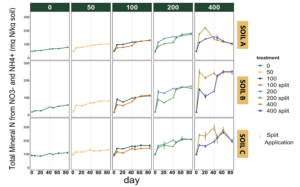
These contrasting patterns suggest that N availability from organic fertilizer is strongly influenced by soil properties. Soil B, which had lower initial mineral N and higher organic matter (OM) content, showed more stable and sustained N release, whereas soils A and C exhibited more transient and variable dynamics. This aligns with previous work showing that N availability tends to be more predictable in soils with higher OM and carbon content (Matus et al. 2007; Gaskell et al. 2007). Building soil organic matter may help reduce variability in N dynamics and improve the efficiency of organic fertilizer use over time.
Implications for Nitrogen Management in Organic Vegetable Production
Our findings suggest that common 4R comma after practices such as banding and split application do not function the same way with organic fertilizers as they do with synthetic sources. Concentrating fertilizer in narrow bands increased localized soil N concentrations but reduced the efficiency of N mineralization, indicating diminishing returns when too much organic material is placed in a small soil volume. In contrast, splitting applications did not increase total N availability but helped maintain a more consistent supply over time, better aligning N release with crop demand. Responses to placement and timing were also strongly soil-dependent. The soil with higher organic matter supported more stable and sustained N availability, while low-OM soils showed more erratic N release. Together, these findings highlight the need to adapt 4R nutrient stewardship for organic systems, with greater attention to soil conditions and practices that build organic matter to improve the consistency and efficiency of nitrogen supply.
Acknowledgments
The authors would like to acknowledge the contributions of Caroline Thomsen, Undergraduate Research Assistant in Natural Resources Management and Environmental Sciences at California Polytechnic State University, San Luis Obispo, and Ava Curtis, Undergraduate Research Assistant in Agricultural Education and Communication at California Polytechnic State University, San Luis Obispo, for their valuable assistance with data collection.
We are especially grateful to the Grimm Family for their generous support of this work and the Grimm Family Center for Organic Research and Production at California Polytechnic State University, San Luis Obispo, for project execution.
We also thank the participating growers for providing soil samples.
Publisher’s Take
The Big Picture: What to do Next
1. Organic fertilizer nitrogen availability depends on microbial mineralization, making timing and placement critical management decisions.
2. Concentrated banding increased localized nitrogen levels but reduced overall nitrogen mineralization efficiency.
3. Split applications helped spread nitrogen release over time but did not increase total nitrogen availability.
4. Soil organic matter strongly influenced how consistently nitrogen was released and retained.
5. Organic nitrogen management strategies may need to differ from conventional 4R approaches to improve efficiency and crop uptake.

Ria Chhabra | Graduate Research Assistant, Plant Sciences, California Polytechnic State University, San Luis Obispo
Matt Grieshop | Director, The Grimm Family Center for Organic Production and Research at Cal Poly
Anna Rodriguez-Paiatsyka | Research Associate and Laboratory Manager, Grimm Family Center for Organic Production and Research, California Polytechnic State University, San Luis Obispo
Allison McLoughlin | Undergraduate Research Assistant, Plant Sciences, California Polytechnic State University, San Luis Obispo