

Rising fertilizer prices and increasing regulatory pressure push growers throughout California to consider decreasing mineral N use. Many growers have become better than ever at practicing the 4 Rs of fertilizer application, right rate, right time, right source, and right placement, but matching N demand with application can be tricky, especially when we don’t have a wide margin of error.
Many fields are also salt-affected, compacted and almost devoid of organic matter. Growers looking to improve soil health and reduce mineral N use should consider supplying some of their crop’s N demand with liquid organic fertilizer. Why? Because plants and soils need more than NPK.
More Than Just NPK
Organic fertilizers and amendments are made from a wide range of materials such as fish byproducts, soy protein, pea protein, blood, bone, corn or manure. Regardless of the source material, all organic fertilizers contain carbon-based compounds that improve both plant health and soil health. While organic growers rely entirely on these products to meet their crop’s nutritional requirements, and although conventional growers have other sources of NPK, organic amendments can help improve nitrogen management, reduce crop stress and boost yield.
‘Healthy soils will help improve your ROI and ensure that the land remains productive for future generations.’
Carbon compounds in organic fertilizers benefit crops directly when they are absorbed by the plant and used to support growth and metabolic functions. Some organic compounds, such as amino acids and secondary metabolites, can be absorbed by plant roots and transported to where they are needed most. Plants can use amino acids as cellular building blocks, saving the energy they’d otherwise use by synthesizing the compounds themselves. Amino acids and other metabolites found in organic fertilizer also act as important signaling molecules, controlling growth and helping plants react and adapt to stressors in their environment.
Microbial N Cycling Improves N Use Efficiency
Amino acids and proteins in organic fertilizers also benefit crops indirectly by improving N cycling in the soil. Beneficial soil bacteria and fungi consume nitrogenous compounds, and excess N not needed to build their cellular structures is released back into soil solution in a plant-available, mineral form. Microbial nitrogen consumption and mineralization provide a slow-release N source and can help prevent nitrate leaching. Microbial biomass serves as a nutrient bank, temporarily storing N until it is released as populations turn over.
N mineralization rates depend on the carbon-to-nitrogen ratio, soil temperature and other factors. Soil amendments containing at least one part N to 20 parts C usually cause net mineralization because they have more than enough N to meet their demand. If the proportion of C:N is higher, usually above 30:1 or 40:1, microbes will use all available nitrogen, immobilizing it until their population dies out. Most liquid organic fertilizers have a low C:N ratio, so N immobilization rarely presents a problem. Growers using organic fertilizer to supplement their conventional crop nutrition program generally supply more than enough mineral N to feed the crop, even if some of the N is temporarily held in microbial biomass. The increased microbial growth resulting from organic amendment application will help prevent nitrate leaching without causing N deficiency.
Increased Microbial Activity Improves Soil Health
Soil microorganisms provide more than an N storage and release system. They are at the heart of soil health, driving organic matter formation, which leads to better structure, pH buffering and water-holding capacity. Soils with higher organic matter content provide more plant-available nutrients and water, and they allow more oxygen to reach the root zone.
Microbial biomass and stable organic matter also help absorb excess salinity, decreasing osmotic pressure that might otherwise cause plants stress. All of these benefits that come along with soil organic matter add up to big improvements in soil health and fertility, providing a hospitable, low-stress environment for crop growth. Less stress and better baseline fertility means growers can spend less on crop nutrition and protection products, boosting ROI.
Building soil organic matter takes time, consistent carbon input and may require adjusting tillage practices. In order to increase soil organic matter, we must increase microbial activity and achieve annual net carbon storage over several years. Microbial activity and biomass drive soil organic matter formation, but microbes also cause carbon loss. Microbial respiration creates a constant carbon flux as microbes absorb the C applied in organic matter and release C as CO2.
High oxygen levels introduced through tillage temporarily spike microbial growth, often leading to annual net carbon loss. Microbial growth is usually limited by oxygen supply, so the sudden surplus drastically increases metabolism and respiration. Following tillage, microbes quickly burn through any carbon source available, depleting the organic matter required to maintain soil health. Reducing tillage can help prevent these microbial population spikes and crashes, allowing more organic matter to build up over time. We want to see microbial respiration in the Goldilocks zone: high enough to show healthy growth and activity, but not so high that microbes will use up all labile carbon and crash when they run out.
Supplement Standard Mineral N With Liquid Organics
Increasing soil organic matter can improve soil health in a multitude of ways, but it requires a carbon input into the system that conventional farming operations often lack. Supplementing the standard mineral fertilizer program with liquid organic fertilizer is a simple and relatively inexpensive way to add carbon and feed the soil microbiome.
AgroThrive, an organic fertilizer manufacturer based in Salinas, California, recommends swapping 20% to 30% of the standard liquid N fertilizer volume with an equal volume of liquid organic fertilizer. Field trials using AgroThrive LF to replace some of the grower-standard mineral N resulted in increased root growth, increased canopy cover, and higher yield in several crops.
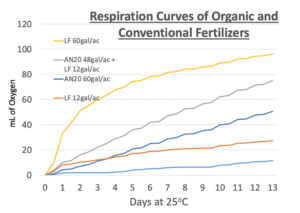
Soil respiration tests conducted by AgroThrive show promising results for the soil’s microbial populations as well.
The company wanted to test the effects of its fertilizer on microbial activity if used in a conventional cropping system to replace 20% of the standard AN20 application. It conducted lab tests comparing soil respiration after application of AN20 alone at 60 gal/ac, AN20 at 48 gal/ac plus 12 gal/ac AgroThrive LF and 12 gal/ac AgroThrive LF alone. The results showed that applying AN20 and AgroThrive together had a synergistic effect on soil respiration. The blended application consumed more oxygen than the sum of the oxygen consumed by the two individual applications alone. This is good news for conventional growers. The data suggests that adding organic amendments to their programs will have a big impact on the soil microbiome.
AgroThrive field tests show significant increases in root biomass, fine root hairs and yield in a variety of crops including lettuce, strawberries, tomatoes and potatoes. Increased soil microbial activity is likely one of the major factors driving these improvements. Other organic fertilizer companies report similar enhancements in root growth, crop quality and yield, suggesting that a variety of carbon-based amendments can support beneficial soil microbial activity.
Measurable improvements in the soil’s physical characteristics and significant increases in stable soil organic matter may take years to develop. In the meantime, growers can benefit from higher rates of microbial activity achieved by applying organic fertilizers.
Growers can track microbiome improvements by measuring soil respiration with a test kit such as Solvita. Respiration test kits are easy to use, relatively inexpensive and provide a good way for growers to compare the effectiveness of different fertilizer blends and application methods.
Adding organic fertilizers to a conventional crop nutrition program can improve soil health, boost crop yield and allow growers to reduce their mineral N application rates. Certified Crop Advisers and representatives from organic fertilizer companies such as AgroThrive can help develop and test protocols to help build soil microbial populations, increase organic matter and improve crop production. Healthy soils will help improve your ROI and ensure that the land remains productive for future generations.
Citations & Resources
1. Bowles TM, Hollander AD, Steenwerth K, Jackson LE (2015) Tightly-Coupled Plant-Soil Nitrogen Cycling: Comparison of Organic Farms across an Agricultural Landscape. PLoS ONE 10(6): e0131888. https://doi.org/10.1371/journal.pone.0131888
2. Gaskell, M., & Smith, R. (2007). Nitrogen Sources for Organic Vegetable Crops. HortTechnology, 17(4), 431-441. https://journals.ashs.org/horttech/view/journals/horttech/17/4/article-p431.xml
3. Hartz, T. K., Smith, R., & Gaskell, M. (2010). Nitrogen availability from liquid organic fertilizers. HortTechnology, 20, 169-172. https://doi.org/10.21273/HORTTECH.20.1.169
4. Lazicki, P., Geisseler, D., Lloyd, M. (2020). Nitrogen mineralization from organic amendments is variable but predictable. J. Environ. Qual. 49: 483-495. https://doi.org/10.1002/jeq2.20030
5. Moebius-Clune, B.N., D.J. Moebius-Clune, B.K. Gugino, O.J. Idowu, R.R. Schindelbeck, A.J. Ristow, H.M. van Es, J.E. Thies, H.A. Shayler, M.B. McBride, D.W. Wolfe and G.S. Abawi. 2016. Comprehensive Assessment of Soil Health: The Cornell Framework Manual, Edition 3.1, Cornell University, Geneva, New York.
6. Soil Health Institute: North American Project to Evaluate Soil Health Indicators. https://soilhealthinstitute.org/north-american-project-to-evaluate-soil-health-measurements/
7. Natural Resources Conservation Service Soil Health Assessment Resources: https://www.nrcs.usda.gov/wps/portal/nrcs/detail/soils/health/assessment/?cid=stelprdb1237387
Publisher’s Take
The Big Picture: What to do Next
1. Liquid organic fertilizers supply carbon compounds in addition to nitrogen, phosphorus and potassium.
2. Amino acids and metabolites can support plant growth and stress tolerance while reducing energy demand on the plant.
3. Low C:N-Ratio liquid organics are unlikely to immobilize nitrogen in conventional systems.
4. Increased microbial activity can improve nitrogen cycling and reduce nitrate leaching.
5. Supplementing conventional fertilizer programs with organics may improve yield and nutrient efficiency.
