

One of my favorite activities to do with my kids is going to the movies. They’re at a perfect age where every new superhero release is the greatest masterpiece ever made. As a sucker for a good deal, I’ll sometimes spring for the refillable popcorn bucket that practically dares you to finish it before the opening credits. Anyone who has consumed enough movie theater popcorn knows the sudden moment when the inside of your mouth becomes dry and wrinkly, sending you searching for something to quench your thirst. You may not realize it, but a concept straight out of high school biology is behind that feeling: the process of osmosis.
Water balance in living cells is highly sensitive to salt concentrations inside and outside the cell. When the environment outside the cells becomes too salty, water moves outward through the cell membrane to equalize concentrations, and that shift is what creates that familiar “wrinkly mouth” sensation.
Plants feel a similar kind of “thirst” when growing in conditions of high salinity. The difference is that while I can stroll to the concession stand for a soda, plants are immobile and don’t have that luxury. Under normal conditions, plants take up water by maintaining higher concentrations of solutes inside their root hairs than in the surrounding soil, pulling water into the root. But when salts accumulate in the soil, the soil solution becomes so concentrated that plants struggle to draw in water. The osmotic gradient reverses, pulling water from the roots.
Plants aren’t entirely helpless. They can adjust internally to tolerate more salts, but the ability to adapt varies by species and usually requires energy that would otherwise support normal plant growth. Ultimately, the plant may wilt, slow growth and potentially even die of thirst, not because water isn’t present in the soil, but because excessive salt has made that water physiologically unavailable.
The Cause and the Cure Is Often the Same: Irrigation Water
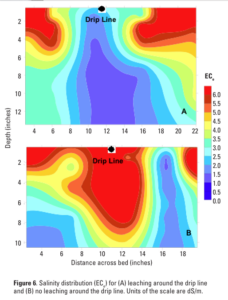
In most agricultural systems, the primary cause of soil salinity is irrigation water itself. Even high-quality irrigation water contains dissolved salts. An acre-foot of irrigation water with an EC of 1.0 dS/m can bring 1 ton of salt to a field. With higher EC water, even more salt than that is imported into the field. Over years of irrigation combined with evapotranspiration, the salts are concentrated in the root zone. In arid regions where rainfall is limited, the source of the problem, ironically, becomes the primary tool we have to manage it.
Leaching is the most reliable and universally recommended method for reducing salinity in the root zone. By applying more water than is required for crop growth, known as a leaching fraction, we use gravity to push accumulated salts below the actively growing roots. It’s not too sophisticated, but it can come with some practical constraints, such as drainage capacity and water availability and cost. Leaching works because salt chemistry is fairly straightforward: Salts tend to go where the water goes.
Soluble Calcium Supports Effective Leaching
Leaching can sometimes be limited, especially if the soil lacks good structure and adequate infiltration. This is where soluble calcium becomes essential. Calcium ions promote flocculation, causing dispersed clay particles to bind into soil aggregates. These aggregates increase soil pore space that lets water move more freely through the soil profile, improving both infiltration at the surface and percolation through the root zone.
“Plants may die of thirst not because water isn’t present in the soil, but because excessive salt has made that water physiologically unavailable.”
Without enough calcium, soils tend to disperse. They can crust at the surface, seal off and become nearly impermeable when irrigation water is applied. The result is ponding or runoff, and unfortunately, the salts remain concentrated around the roots. Supplying soluble calcium through amendments can dramatically improve soil physical properties, making leaching far more effective. Gypsum (calcium sulfate) is the most common calcium amendment, but there are other soluble calcium sources available as well.
Unlocking Calcium in Calcareous Soils
Many Western agricultural soils contain abundant calcium, but much of it is tied up in the form of calcium carbonate (lime). On paper, these soils appear to have all the calcium we could ever want. The challenge is that calcium carbonate has limited solubility, so most of the calcium in calcareous soils is effectively locked up and unavailable to improve soil for effective leaching.
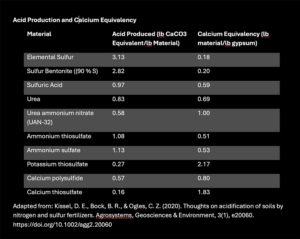
In these calcareous soils, acid-forming amendments can be extremely valuable. Acid dissolves calcium carbonate, releasing the calcium into the soil solution. A rule of thumb that was once recommended to me is when calcium carbonate in the soil is above 1%, an acidifier can be used to free calcium. When it’s below 1%, it’s best to use a calcium source. One other advantage to choosing an acidifier is that many acid-forming products also supply essential plant nutrients, offering a dual benefit.
The accompanying table shows both the acidity generated by an amendment (expressed as calcium carbonate equivalency) and its gypsum equivalency. Calcium carbonate equivalency indicates how much lime the produced acid can neutralize. The higher the value, the stronger the acidification. Gypsum equivalency reflects how effectively an acid amendment dissolves soil calcium carbonate to release plant-available calcium relative to an application of gypsum. The lower the number, the more calcium is produced. It’s also important to note that calcium polysulfide and calcium thiosulfate act as both acidifiers and sources of soluble calcium.
Summary
Managing soil salinity isn’t a one-time fix, but a long-term strategy that blends water management, soil chemistry and soil physical health. Irrigation water introduces salts, but with effective leaching, adequate soil structure and a thoughtful approach to supplying or unlocking soluble calcium, salts can be leached out of the root zone. While there’s no single silver bullet, consistent monitoring, smart amendment choices and proper irrigation management can keep salinity-affected soils productive and ensure crops have access to the water they need, even in challenging environments where salt happens.
Publisher’s Take
The Big Picture: What to do Next
1. Irrigation water always adds salts to the soil, even when water quality is considered good.
2. Salts accumulate over time through evapotranspiration and limited rainfall, especially in arid regions.
3. Leaching is the most effective salinity management tool, but it requires adequate drainage and infiltration.
4. Soil structure directly affects how well salts can be flushed below the root zone.
5. Regular monitoring of EC levels and irrigation quality can help prevent long-term yield losses.
