

Abstract
Weather and climate variability has direct influence on agricultural production systems. While weather data are typically freely available, their application in farm level decision-making is limited due to lack of translation into actionable information. CalAgroTools is a climate-informed decision support system designed to bridge this gap by transforming raw weather and climate data into crop-specific, location-specific advisory tools. CalAgroTools was developed in partnership between University of California Agriculture and Natural Resources and USDA California Climate Hub with funding support primarily from USDA and from the UCOP. This article provides a comprehensive technical overview of CalAgroTools, its data infrastructure, analytical framework, and practical applications for agricultural clientele.
Introduction
Agricultural production is inherently sensitive to weather and climate variability. Temperature extremes, precipitation variability, and shifting seasonal patterns directly affect crop phenology, pest dynamics, irrigation demand, and overall yield potential. For progressive crop consultants, the ability to anticipate and respond to these environmental factors is increasingly critical.
Despite the availability of extensive weather and climate datasets, a key challenge remains: raw data alone does not translate into actionable agronomic decisions. Growers and consultants require interpreted, crop-relevant indicators rather than raw temperature or precipitation values. This gap between data availability and decision usability has historically limited the integration of climate information into routine farm management.
CalAgroTools addresses this challenge by providing a data-driven, user-oriented platform that converts complex environmental datasets into practical decision-support tools tailored to specific crops and locations. The system is designed to support both strategic planning and in-season management, enabling consultants to deliver more precise, timely, and risk-informed recommendations.
Data Sources
The gold standard for agricultural weather data is a well-maintained, on-farm weather station. These stations provide highly localized measurements of temperature, humidity, wind, and precipitation, allowing for precise monitoring of microclimatic conditions. However, installing weather station uniformly across the agricultural region is not practical due to the limitations of installation costs, maintenance requirements, and data quality concerns. To address gaps in station coverage, CalAgroTools relies on high-resolution gridded datasets. Gridded data offer spatially continuous coverage and are not dependent on individual station availability. One of the primary sources is PRISM (Parameter-elevation Regressions on Independent Slopes Model, https://prism.oregonstate.edu), which provides climate data at multiple spatial resolutions.
Traditional PRISM products operate at a 4 km × 4 km resolution, which may not adequately capture localized variability in complex agricultural landscapes. CalAgroTools utilizes higher-resolution datasets (800 m), significantly improving spatial accuracy and relevance for field-level decision-making. This finer resolution is particularly valuable in regions with heterogeneous topography or microclimates. Another advantage of PRISM gridded data is that it is quality controlled and there is no issue of missing data.
In addition to historical and near-real-time data, CalAgroTools incorporates short-term weather forecasts from the National Weather Service. Seven-day forecasts are integrated into advisory tools, enabling forward-looking decision support. Forecast data are processed and visualized in formats that emphasize risk thresholds and management triggers rather than raw meteorological variables.
Decision Support Tools
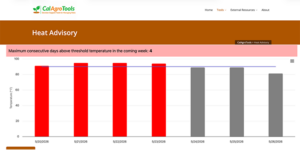
Heat Advisory Tool
Heat stress is a major limiting factor for many crops, particularly during critical growth stages such as flowering, pollination, and fruit set. The Heat Advisory Tool in CalAgroTools goes beyond simple temperature thresholds by integrating duration, intensity, and timing of heat exposure relative to crop phenology. This enables a more meaningful assessment of heat stress risk.
The tool incorporates user defined crop-specific critical temperature thresholds, and it evaluates consecutive days of high temperatures, which often have compounding physiological impacts such as reduced pollen viability, impaired photosynthesis, increased evapotranspiration demand, and potential yield losses.
Forecast integration allows users to identify impending heat events up to seven days in advance. Visualization outputs highlight both severity and duration, enabling rapid interpretation.
Example of Applications:
• Scheduling additional irrigation to reduce evapotranspiration (ET) demand and crop stress
• Adjustment of fertilizer and foliar spray programs to avoid stress amplification
• Putting shade structures or cooling practices in high-value crops
• Planning to reduce farm worker exposure during extreme heat events
Frost Advisory Tool
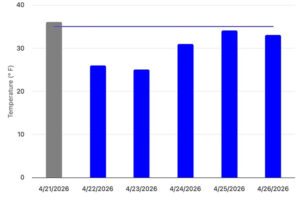
Frost events represent one of the most acute and localized weather risks for frost sensitive crops. The Frost Advisory Tool lets user define minimum temperature threshold that could be specific to crop tolerance level and provide six-day frost risk forecasts. Unlike standard weather forecasts, this tool focuses on crop-relevant thresholds such as critical damage temperatures for specific growth stages. The system accounts for duration of subcritical temperatures, as frost exposure for many consecutive days can have detrimental impacts on crops as opposed to just one day of frost exposure.
Advanced Applications:
• Targeted activation of frost protection systems (wind machines, micro-sprinklers, heaters)
• Optimization of fuel and water use during frost events
Crop Phenology Tool
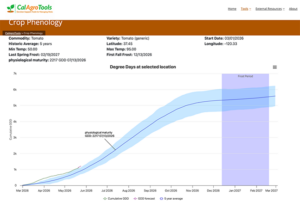
Crop phenology tool is Growing Degree Days (GDD) based tool and are a foundational metric for tracking crop development. CalAgroTools enhances traditional GDD calculations by incorporating high-resolution spatial data, customizable base temperatures, crop-specific developmental thresholds, as well as 6-days of weather forecast based GDD forecast.
The tool supports both single-sine and double-sine calculation methods and allows users to select upper temperature cutoffs to better reflect biological limits. In addition to cumulative GDD, the system provides percentile comparisons against historical seasons, enabling users to contextualize current conditions.
Outputs include stage-based visualizations that map GDD accumulation to key phenological milestones such as emergence, flowering, and maturity.
Advanced Applications:
• Fine-tuning planting and harvest schedules based on seasonal progression
• Synchronizing management operations (e.g., thinning, fertilization) with crop developmental stages
• Comparing current season development against historical analog years
Pest Advisory Tool
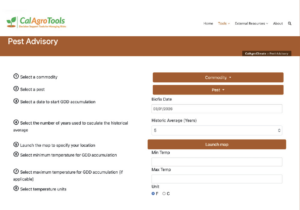
Pest development is closely linked to temperature-driven biological processes. The Pest Advisory Tool leverages degree-day model to predict pest emergence, development stages, and generations.
The system supports multiple pest models and allows customization based on local validation data mainly derived from UC IPM sources. It integrates both historical and forecasted weather data to provide forward-looking risk assessments.
Advanced Applications:
• Precision timing of pesticide applications to target vulnerable pest life stages
• Reduction of chemical inputs through avoidance of unnecessary or poorly timed applications
• Integration with scouting data to refine thresholds and improve model accuracy
Agroclimatic Indicators
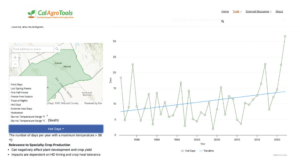
Agroclimatic indicators provide a holistic assessment of environmental conditions affecting crop performance by integrating multiple variables into composite metrics. These indicators move beyond single-factor analysis to capture interactions between temperature driven thresholds.
CalAgroTools generates historical trends in indicators such as frost days, last spring freeze, first fall freeze, freeze free season, extreme heat, and diurnal temperature ranges for selected region within the county that represents user defined area of interest. These indicators are updated annually as new historical data becomes available.
The platform also enables spatial comparison across regions, supporting benchmarking and regional planning.
Advanced Applications:
• Identifying long-term trends for climate adaptation strategies
• Supporting crop suitability assessments and variety selection
• Integrating with economic models to assess risk and profitability
• Strategic regional agricultural investments based on the historical climate risks
Usability and Applications
CalAgroTools represents a shift from simple data access toward decision support for agriculture. By integrating high-resolution climate data with crop-specific models, the platform enables consultants to move beyond generalized recommendations and deliver precise, field-level, crop-specific guidance. This level of spatial and temporal specificity is particularly valuable in regions with high microclimatic variability, where small differences in temperature or moisture conditions can translate into significant agronomic outcomes. As a result, consultants are better equipped to tailor management strategies to individual blocks, improving both efficiency and effectiveness.
The practical value of CalAgroTools is best illustrated through its application across diverse cropping systems, where climate variability directly influences management outcomes. In perennial orchard systems such as almonds, pistachios, and grapes, the timing and intensity of temperature extremes during sensitive phenological stages can have disproportionate impacts on yield and quality. By integrating frost and heat advisory tools with real-time and forecasted data, consultants can identify narrow windows of elevated risk and implement targeted mitigation strategies. For example, during bloom or early fruit set, even short-duration frost events can significantly reduce yield potential, while heat stress can impair pollination and fruit development. CalAgroTools enables to get early indication of these risks to help growers and consultants optimize the use of existing resources to mitigate risks.
“CalAgroTools enables consultants to move beyond generalized recommendations and deliver precise, field-level, crop-specific guidance.”
In annual crop systems such as processing tomatoes, cotton, corn, and other field crops, the platform supports more precise alignment of management practices with crop developmental stages. Growing Degree Day tracking allows consultants to monitor crop progression relative to historical norms and anticipate shifts in crop stages such as emergence, flowering, and maturity. This information can be used to refine planting schedules, optimize irrigation timing, and coordinate scouting and harvest logistics. Additionally, the integration of heat advisories helps mitigate stress during critical growth periods, improving both yield and quality outcomes in seasons characterized by extreme temperature variability.
CalAgroTools also plays a central role in advancing integrated pest management strategies across cropping systems. By linking pest development models to temperature-driven dynamics, the platform enables consultants to synchronize monitoring and intervention efforts with pest life cycles. This results in more effective and timely control measures, reducing reliance on routine or calendar-based pesticide applications. In practice, consultants can combine pest advisory outputs with field scouting observations to refine action thresholds and improve overall management precision.
Partnership between UCANR and USDA California Climate Hub
A major strength of CalAgroTools has been the collaborative partnership between the USDA California Climate Hub director Steven Ostoja and University of California Agriculture and Natural Resources. This partnership has been productive in integrating climate science with practical, field-level agricultural expertise, so that the platform remains scientifically robust and operationally relevant for growers and crop consultants. The involvement of extension specialists and advisors has been particularly valuable in identifying producer needs, validating tool functionality under real-world conditions, and translating complex climate information into actionable management guidance. CalAgroTools system is constantly evolving based on the feedback we receive. We are in the process of adding several additional tools in coming months and year that are envisioned to bridge the gap of existing tools and resources available. Please feel free to reach out and provide feedback on any additional tools you would like to see on CalAgroTools system.
Visit the website: https://calagrotools.org
Publisher’s Take
The Big Picture: What to do Next
1. CalAgroTools converts raw weather and climate data into crop-specific, field-level decision support tools.
2. The platform integrates real-time weather, historical climate trends and seven-day forecasts to improve risk management.
3. Heat, frost, pest and crop development tools help growers make more precise irrigation, fertility and crop protection decisions.
4. High-resolution 800-meter gridded climate data improves accuracy in regions with diverse topography and microclimates.
5. Climate-informed management can improve timing, reduce unnecessary inputs and help growers adapt to increasing weather variability.

Tapan Pathak | Associate Professor of Cooperative Extension, UC Merced
Prakash Jha | Project Scientist, UC Agriculture and Natural Resources
Ning Zhang | Postdoctoral Scholar, UC Davis
Shane Feirer | Informatics and GIS, UC Agriculture and Natural Resources
Robert Johnson | Informatics and GIS, UC Agriculture and Natural Resources