

Soils contain vast numbers of microorganisms, including bacteria, fungi, and archaea. Most have neutral or positive effects on plant growth, and some are pathogenic. Only 2% to 5% of soil microbes are classified as plant growth-promoting rhizobacteria (PGPR). PGPRs are bacteria that directly benefit plant health by enhancing growth, stimulating stress defense pathways, and fighting off pathogens. These species reside primarily in the rhizosphere, the soil directly covering root surfaces, but some PGPRs, known as endophytes, live within the plant itself. Bacterial endophytes colonize plant tissue, forming a symbiotic relationship with their host. Their proximity to plants provides higher potential to enhance crop health compared with other PGPRs residing further away from plant cells.
Endophytes are found living within plant roots, stems, leaves, flowers, and even in seeds before germination. The plant provides a safe, hospitable environment for the bacteria, while the bacteria provide the plant with nutrients, phytohormones, and pathogen suppression. Most ag professionals are familiar with rhizobium, the bacteria that colonize soybeans and other legumes, forming distinctive pink nodules in the roots. Farmers value rhizobium for their ability to fix atmospheric nitrogen and offset some of the crop’s nitrogen fertilizer demand. Rhizobium, like other endophytes, also promote growth, enhance the plant’s stress tolerance, and help ward off pathogens. Other types of endophytes include Bacillus species, PaeniBacillus, Agrobacterium, Pseudomonas, Burkholderia, and more. Most of these organisms do not create nodules in plant roots, so colonization cannot be detected with the naked eye. Under the microscope, however, we can observe bacteria colonizing the spaces between plant cells and sometimes living within plant cells.
“Other endophytes enhance photosynthesis, resulting in higher carbohydrate production and increased plant growth.”
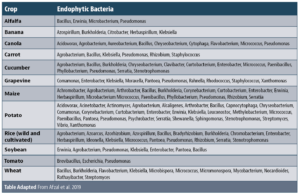
Researchers estimate that roughly 300,000 species of plants can host endophytes. Some endophytes have adapted to live within specific plant hosts, but many have a broad host range and can colonize several types of important agricultural crops. Pseudomonas fluorescens, for example, colonizes tomatoes, alfalfa, canola, carrots, cotton, and grapevines. Other types of endophytes have been shown to enhance growth and crop quality of wheat, corn, potatoes, radishes, and more. Several medicinal plants such as ginseng, ginkgo biloba, coriander, and lavender also benefit from endophytic colonization, yielding crops with higher levels of medicinal compounds.
How Endophytes Support Plant Growth
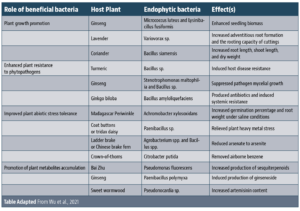
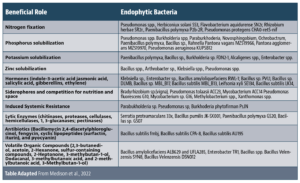
Endophytes can promote plant growth in several ways depending on the type of endophytic bacteria and environmental conditions. Some endophytes increase root and shoot biomass by excreting indole acetic acid, an important plant metabolite that regulates growth. Other endophytes, such as rhizobia and Serratia species, boost growth by fixing atmospheric nitrogen to share with their host. Other types of endophytes enhance photosynthesis, resulting in higher carbohydrate production and increased plant growth. Endophytic colonization can also alter root morphology, increasing root branching and fine root hair growth. Robust root systems increase nutrient and water uptake, thus increasing growth potential above their counterparts with smaller or less efficient root systems.
Building Tolerance to Environmental Stress
Plants colonized with endophytic bacteria also exhibit greater tolerance to environmental stress. Soil and water salinity often limit production, but endophytic bacteria can help prevent damage. Endophytic bacteria influence phytohormone and metabolite levels to mitigate osmotic pressure by adjusting the osmolyte concentration in cellular fluids. These changes help the plant absorb enough water without taking up toxic levels of salts. Other metabolic changes induced by bacteria help regulate stomatal closure to conserve water and avoid desiccation during periods of drought. Endophytes induce similar physiological adaptations to protect plants from extreme heat or freeze spells.
Nutrient Availability and Uptake
Endophytic bacteria can also help mitigate plant stress symptoms caused by nutrient deficiency. Some endophytes produce nutrient-solubilizing and chelating agents, significantly increasing phosphorus and iron bioavailability and absorption. Most agricultural soils contain plenty of phosphorus, but most of it is found in insoluble forms. Endophytes can secrete acidifying agents and complexing agents to dissolve mineral phosphate, bind it, and deliver it to the plant in a bioavailable form. Phosphate solubilization is a common function among endophytes, with 59 to 100% of endophytic bacteria found in cactus, strawberry, sunflower, and soybeans exhibiting the trait. Similarly, many endophytes produce iron chelating agents called siderophores. Iron has very low solubility, and most soil iron is bound in mineral complexes with carbonates, hydroxides, oxides, and phosphates. Endophytes produce siderophores that bind to insoluble ferric (Fe3) ions, allowing the plant to absorb iron that would otherwise remain inaccessible. Siderophore production has been shown to support iron nutrition and growth of tomatoes, corn, and other crops.
Suppressing Pests and Disease
Endophytic bacteria not only promote crop growth, but they also suppress pests and disease. While siderophore production feeds plant hosts, it can also help fight off soilborne pathogens. Some types of siderophores bind iron in a form that is accessible to plants, but unavailable to certain disease organisms. Pathogens that lack the enzymes necessary to metabolize the siderophores become iron deficient, causing their population growth to slow or even crash. Thus, the endophytes are supporting crop growth both by increasing plant nutrient uptake and by starving out disease agents.
“Biological products have one important characteristic in common: They all seek to stimulate beneficial microbial activity to enhance crop health.”
Endophytic bacteria can also suppress pathogens by producing antibiotics, enzymes, and other compounds that fight off both fungal and bacterial disease. Successful fungal pathogen suppression has been shown in multiple crops including wheat, potato, and black pepper. Endophytes produce the enzymes chitinase, proteases, and gluconases that break down fungal cell walls, killing the pathogens. Bacillus subtilis, Pantoea vagans, and other endophytes display effective bacterial pathogen suppression, although the mechanisms involved are not as clearly understood. Other endophytes have been shown to suppress pathogenic nematodes and insect pests such as sugarcane borer larvae. Endophytic antibiotic production offers a powerful crop protection tool, but endophytes also help crops protect themselves by inducing systemic resistance to pests and pathogens. Endophytic bacteria modulate the plant’s gene expression to build stronger cell walls and produce their own antibiotic compounds to suppress pathogenic growth. Endophytic bacteria including Bacillus, Pseudomonas, and Serratia species have all demonstrated pathogen suppression by initiating induced systemic resistance in their plant hosts.
Evaluating Biological Products in the Field
Research shows that many major crops benefit from bacterial endophyte colonization, but applying the knowledge in the field remains challenging. Growers and crop consultants see an endless train of new biological products on offer. Each new formulation claims to stimulate growth, reduce crop stress, and suppress pathogens. How do we differentiate between these products? How do we know which products work, when the effects are so difficult to measure? Biological products have one important characteristic in common: They all seek to stimulate beneficial microbial activity to enhance crop health. Search the scientific literature to find research on the bacterial species in the products you consider. For example, a paper published in Frontiers, an open access journal, shows improved growth and increased chlorophyll production in lentils inoculated with two different types of endophytes (see figure at left). Many biological manufacturers conduct extensive product testing and will share similar study reports upon request. Look for products with quantified field-test results across multiple crops and locations and test the product in your own split-block trial before implementing it at a larger scale.
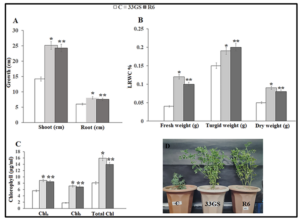
Effect of bacterial treatment on (A) root and shoot length of the plant, (B) chlorophyll content of the leaves of all the treated plants, (C) leaf relative water content, (D) growth of lentil plants with uninoculated control, S. plymuthica 33GS and Serratia sp. R6. Values bearing different signs (*, **, ***) differ significantly (P ≤ 0.05). (Source: Debnath et al., 2023.)
Ongoing work will help elucidate the most effective ways to manage beneficial bacterial endophytes in agriculture. Efficacy depends on the compatibility between the crop and type of endophytic bacteria. Environmental factors such as soil type, fertility, and climate also affect endophytic activity, and should be taken into consideration when determining field management practices and biological application strategies. For example, supplementing your fertilizer program with liquid organic materials can help promote beneficial bacterial growth in soils, improving inoculation efficacy. There are already many bacterial products and soil amendments on the market developed for a wide range of crops and soil types. Although more research would be helpful, many of these biologicals are worth trying now. Consult with your Certified Crop Adviser to learn more about soil health and the management practices that promote beneficial bacterial growth. CCAs can help you select the products, application methods, and other protocols to improve product efficacy and maximize production.
Sources:
Imran Afzal, Zabta Khan Shinwari, Shomaila Sikandar, Shaheen Shahzad,
Plant beneficial endophytic bacteria: Mechanisms, diversity, host range and genetic determinants, Microbiological Research, Volume 221, 2019, Pages 36-49, ISSN 0944-5013,
https://doi.org/10.1016/j.micres.2019.02.001.
(https://www.sciencedirect.com/science/article/pii/S0944501318304592)
Debnath S, Chakraborty S, Langthasa M, Choure K, Agnihotri V, Srivastava A, Rai PK, Tilwari A, Maheshwari DK and Pandey P (2023) Non-rhizobial nodule endophytes improve nodulation, change root exudation pattern and promote the growth of lentil, for prospective application in fallow soil. Front. Plant Sci. 14:1152875. doi: 10.3389/fpls.2023.1152875
Hallmann, J., Quadt-Hallmann, A., Mahaffee, W., Kloepper, J., 1997. Bacterial endophytes in agricultural crops. Can. J. Microbiol. 43, 895–914.
Rosenblueth, M., Martínez-Romero, E., 2006. Bacterial endophytes and their interactions with hosts. Mol. Plant Microbe Interact. 19, 827–837.
Miliute, I., Buzaite, O., Baniulis, D., Stanys, V., 2015. Bacterial endophytes in agricultural crops and their role in stress tolerance: a review. Zemdirbyste-Agriculture 102, 465–478.
Medison RG, Tan L, Medison MB, Chiwina KE. Use of beneficial bacterial endophytes: A practical strategy to achieve sustainable agriculture. AIMS Microbiol. 2022 Dec 27;8(4):624-643. doi: 10.3934/microbiol.2022040. PMID: 36694581; PMCID: PMC9834078.
Publisher’s Take
The Big Picture: What to do Next
1. Know what is in the product.
Look at the bacterial species included in biological products and review available research on how those organisms perform.
2. Match biology to field conditions
Crop compatibility, soil type, fertility and climate can all affect endophyte activity and product efficacy.
3. Look beyond the product claims
Ask for quantified field-test results across multiple crops and locations before making recommendations.
4. Test before going all in
Use a split-block trial to evaluate a biological product under your own field conditions before expanding its use.
5. Consider the whole production system
Management practices that support beneficial bacterial growth can influence how well an inoculant or biological product performs.
