

Introduction
As a leafy brassica, bok choy (Brassica rapa subsp. chinensis) needs reliable nitrogen during its short growth cycle to build healthy green tissues. However, this fast-cycling growth characteristic leaves growers, especially in the Central Valley, a narrow window of nitrogen application. With the crop typically going from seeding to harvest in less than 60 days due to the Mediterranean climate, a majority of the required nitrogen should be applied during bok choy’s active vegetative growth period, for example, the first 50 days. The timing constraint poses the risk of mismanagement of nitrogen, leading to either nutrient deficiency or nitrogen leaching caused by excess application.
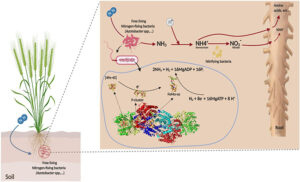
Biostimulants containing nitrogen-fixing bacteria may offer an alternative way to address the challenge of mismatching nitrogen application and crop uptake. Instead of being immediately available after fertilization, many species of these soil bacteria, also recognized as the free-living plant growth promoting rhizobacteria (PGPR), are known to fix atmospheric nitrogen gas into nitrate prior to crop use (Figure 1). They can inoculate roots of a wide variety of commodities from annual row crops and vegetables to perennials for fixing nitrogen, which is called non-symbiotic nitrogen fixation. Under real farm conditions, these beneficial microorganisms are typically delivered as formulated commercial biostimulant products via soil drenching, seedling soaking, foliar spray, or injection. This study was planned to assess the bok choy nitrogen dynamics in response to different application rates of a nitrogen-fixing biostimulant.
Methods
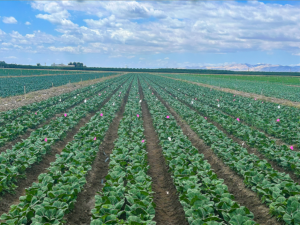
Experimental site: The trial was conducted within a commercial bok choy field in Modesto, California. The soil type was loam and sandy loam. The trial was set up in a randomized complete block design with four replicated blocks and five treatments (untreated control + four rates of biostimulant). The site consisted of 20 treatment plots, each 50 feet in length. Bok choy was seeded on 40-inch-wide beds with double seed lines (Figure 2). All plots were managed identically as the rest of the field using the grower’s standard practices.
Treatment application
After seeding on April 16, 2026, all plots received the same standard fertility program independent of biostimulant treatment. UAN-32 was applied at 10 gal/acre at 2 days after seeding (DAS), followed by CAN-17 at 43 DAS at 15 gal/acre and again at 51 DAS with 23 gal/acre. The biostimulant used in this trial is a microbial soil and foliar inoculant containing a consortium of beneficial nitrogen-fixing bacteria such as Azospirillum spp. and Azotobacter spp. All biostimulant applications were made as a foliar spray with a backpack sprayer in the early mornings to avoid evaporation and improve plant absorption.
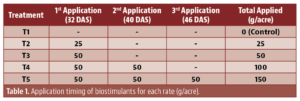
The trial consisted of four application rates (25, 50, 100, and 150 g/acre). Specifically, treatments with higher rates were built up through sequential applications at a 50 g/acre increment rather than applied all at once (Table 1). The first foliar application was made at 32 DAS during the early vegetative stage. A total of 0.4 g product was mixed into 1.5 gallons of water to cover the T2 plots (25 g/acre), while a separate 2.4 g was mixed into 4.5 gallons of water to cover the T3-T5 plots (50, 100, and 150 g/acre). The second application was made at 40 DAS by mixing 1.6 g product into 3 gallons of water covering the T4 and T5 plots, and the third application was made at the pre-harvest stage (46 DAS) with 0.8 g product mixed into 1.5 gallons of water covering only the T5 plots (Table 1).
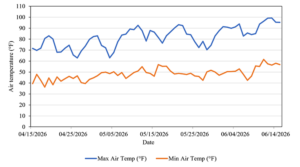
Growing conditions – air temperature: Temperatures gradually increased over the course of the season (Figure 3). Daily high temperatures averaged around 70 F in mid-April and increased to the mid-90s by mid-June, while daily low temperatures increased from the 40s to the mid-50s as the season progressed.
Data collection:
We took the following measurements:
• NDVI readings for vegetative growth
• Plant nitrogen accumulation in aboveground biomass
• Crop nitrogen uptake and soil nitrate-N
• Bok choy yield (harvested on June 15)
Data/Results
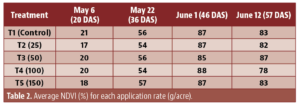
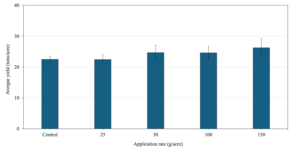
Yield and NDVI response to application rate: Overall, higher application rates did not warrant an obvious yield advantage (Figure 4). Bok choy inoculated at the rate of 50 g/acre and higher produced almost the same yield though all were slightly higher than the control and the lowest rate (Figure 4). We did not observe any differences in the NDVI among treatments. The canopy reached maximum coverage at 46 DAS and was well sustained until three days before harvest (57 DAS, Table 2).
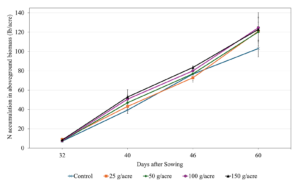
Nitrogen accumulation in aboveground biomass: Bok choy aboveground biomass was sampled four times from each treatment. Oven-dried plant samples were submitted to a commercial lab for total percent nitrogen, which was then converted into cumulative nitrogen (Figure 5). All treatments followed a similar nitrogen accumulation pattern throughout the season, climbing from roughly 8 lb/acre at 32 DAS to over 120 lb/acre by harvest at 60 DAS except for the control plot (Figure 5). Although we saw a 15 to 20 lb/acre advantage in nitrogen accumulation compared to the non-inoculated control, increasing the inoculation rate barely elevated plant nitrogen accumulation (Figure 5). This observation could inform growers that adding biostimulants containing nitrogen-fixing PGPRs at an appropriate rate may enhance crop nitrogen accumulation.
Nitrogen Uptake at Each Measurement
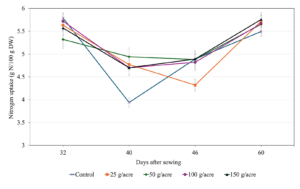
Nitrogen uptake for all treatments started near 5.4-5.8 g N/100 g dry weight (DW) at 32 DAS, dropped through the 40 and/or 46 DAS sampling points, and recovered by harvest (Figure 6). It is noteworthy that compared to the inoculated treatments (4.7-4.9 g N/100 g DW), nitrogen uptake in the control plots dropped much lower to below 4 g N/100 g DW at 40 DAS (Figure 6). This may indicate that biostimulant applications, especially at a higher rate, might have provided additional nitrogen for plant uptake at mid-season, which is an important stage for leaf growth and the final yield.
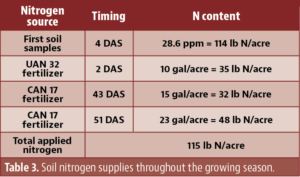
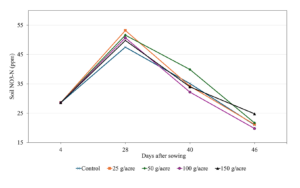
Available nitrogen and applied nitrogen fertilizer: Three fertilizations were made in the early and mid-late season, contributing to a total of 115 lb N/acre (Table 3). The first soil samples were taken at 4 DAS (2 days after the application of UAN-32) prior to seed emergence. An average of 28.6 ppm of nitrate-N from 1-foot cores translates to roughly 114 lb/acre early season total available nitrogen in the 0-12” profile (Table 3). Soil samples were taken again at 28 DAS (pre-biostimulant) and post-biostimulant at 40 and 46 DAS for the real-time nitrate-N. Soil nitrate-N rose sharply from the 4 DAS baseline to a peak of roughly 47-53 ppm at 28 DAS with the contribution of full release of UAN-32 and then declined steadily across all treatments through 40 and 46 DAS when the crop was within the peak nitrogen demand (Figure 7). Still, soil nitrate-N from inoculated plots (50 and 150 g/acre) at 40 and 46 DAS was slightly higher than other treatments (Figure 7). A third fertilizer application, at 51 DAS, occurred after the final soil sample and is not reflected in this balance. The aboveground biomass nitrogen data (Figure 5) showed that bok choy accumulated 75-84 lb N/acre by 46 DAS, compared to a total of roughly 175 lb N/acre supplied from soil residues and first two fertilizer applications, well aligning with the remaining ~80-100 lb N/acre in the soil at 46 DAS (Figure 7).
Discussion and Takeaways
Overall, adding N-fixing microbial inoculants slightly increased bok choy yield, total nitrogen accumulation, and left a higher level of remaining soil nitrogen, especially using the higher inoculation rate. It is noteworthy that the field received the same amount of nitrogen fertilizer across all treatments, which differed from other studies where inoculated plants typically received a reduced nitrogen application. This may explain the limited increase in productivity and nitrogen uptake after bok choy was treated.
Application rate is another frequently asked question. At least in this study, the maximum rate did not translate into a superior yield over the others, raising questions about the balance between crop performance and budget. However, we should take the short growing cycle of bok choy into consideration and reasonably expect different outcomes for longer season commodities, such as tomato and cucurbits. The first year’s outcomes should be considered more as a trend showing positive impacts of biostimulants. As more products and crops are being investigated, we will generate more solid information on the optimal practice of biostimulant application.
Reference:
Aasfar, A., Bargaz, A., Yaakoubi, K., Hilali, A., Bennis, I., Zeroual, Y., & Meftah Kadmiri, I. (2021). Nitrogen fixing Azotobacter species as potential soil biological enhancers for crop nutrition and yield stability. Frontiers in Microbiology, 12, 628379.
Publisher’s Take
The Big Picture: What to do Next
1. Biostimulant treatments showed a positive trend
Inoculated bok choy had slightly higher yield and greater nitrogen accumulation than the untreated control.
2. More was not necessarily better
Increasing the biostimulant rate above 50 g/acre did not produce an obvious yield advantage.
3. Midseason nitrogen dynamics may be important
Nitrogen uptake dropped more sharply in the untreated control at 40 days after seeding than in inoculated treatments.
4. Nitrogen supply matters when interpreting the results
Every treatment received the same fertilizer program, totaling 115 lb N/acre, which may have limited the additional response attributable to the microbial inoculant.
5. These results are a starting point, not a prescription
The researchers characterize the first-year findings as trends and plan additional work to better define optimal biostimulant practices across products and crops.

Ajay Dhukuchhu | UCCE Stanislaus County
Yaritza Castrejon | UCCE Stanislaus County
Navneet Kaur | UCCE Stanislaus County