

There is a new cover crop tool available for growers, technical assistance providers, crop advisors and other users in the West. Cover crops provide many benefits because they keep soil covered, maintain living roots that support microbial life and integrate a new plant species into the crop rotation. In an annual cropping system, cover crops are planted on ground that would otherwise be fallow, while in an orchard or vineyard, cover crops are planted between plant rows. The Cover Crop Species Selector is a cover crop database and a species selector tool. In September, states in the West were added to this national resource, including California, Oregon, Washington, Idaho, Alaska, Hawaii, Colorado, Arizona, New Mexico, Nevada, Wyoming, Utah, and Montana.
How the Tool Works
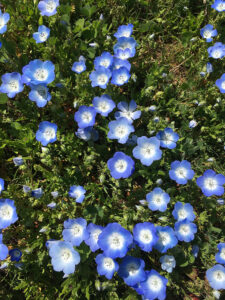
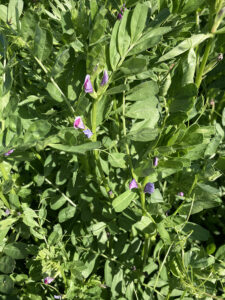
Start by selecting your state. This filters down to a list of cover crop species commonly grown in that state. For example, three native species are included for California. Then select either “Get a Recommendation” or “Browse Cover Crops.” Browsing allows you to explore the traits of many different cover crops used in your state. Once you select a cover crop you’re interested in, you’ll see a description of the species and photos, as well as information about basic agronomics, environmental tolerances, tolerable soil conditions, and growth habit. Planting considerations include seeding rate and depth, and typical seeds per pound. Termination methods and timing guidelines are also included. The tool includes relevant notes such as grazing limitations, planting and establishment nuances, and pest and disease information related to crops in nearby fields or the following crop. Each cover crop species is also rated for seed persistence, residue management challenges, and volunteer establishment in following crops.
Building a Recommendation
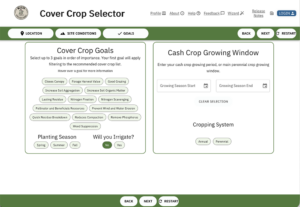
To “Get a Recommendation,” select your field location. This automatically pulls soil and environmental data for the field, including soil texture and drainage class, which can be changed, frost dates and precipitation. Then choose from a list of 14 goals. Up to three goals can be selected and adjusted in order of priority. To optimize recommendations, select your cover crop planting season and indicate whether you will irrigate the cover crop. Also identify your cash crop growing window, as well as cropping system, annual or perennial.
Comparing Cover Crop Options
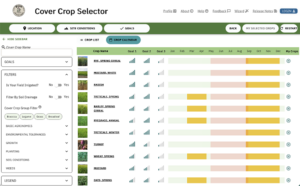
The following page leads to a ranked list of all cover crops for the state based on your goals, climate, and soil type. The first goal selected, Goal 1, is an important sorting and filtering component of the data set. You can reorder goals by clicking on the column headers for your goals, but this does not generate a new list of recommended cover crops. To get a new recommendation based on new or reordered goals, return to the goals tab. The output page also depicts the reliable cover crop establishment window for each species, with the user-inputted cash crop growing window overlaying it. This visual shows whether there is an overlap with an annual crop or a conflict in management window for a perennial system. Cover crop species are grayed out if the species rank low for Goal 1 or if the reliable establishment window conflicts with the cash crop season. You can click on individual cover crop species names to see the information sheet for that species. Finally, the tool has a variety of filters that allow the user to narrow results even further. We recommend not overfiltering the results and instead exploring different cover crop species in the database that are highly ranked for the user’s goals, location, and growing window.
Built by Regional Experts
The data set for this tool was created by experts in the Western states, including researchers, Extension professionals, farmers, natural resource partners, seed industry representatives and nonprofit representatives. Data was curated in a three-tiered structure, with groups of experts meeting at the All West, ecoregion and state levels. In total, there were 20 groups of experts. Six U.S. EPA ecoregions were included, representing the western states in the continental United States. Each group ranked cover crop species based on a set of data points. A review of past research was conducted to complement the data verification discussions. Beta testing was conducted before the tool was launched.
The Western Cover Crops Council led data verification for this tool and worked closely with a data steward and development team from Precision Sustainable Agriculture. Funding was provided by the USDA Natural Resources Conservation Service.
The tool can be accessed through the Western Cover Crops Council website or at covercrop-selector.org. We welcome feedback. This tool was created based on expert opinion. If you have experience with a cover crop species that does not match the information in the tool, please write us a note in the Feedback tab.

Publisher’s Take
The Big Picture: What to do Next
1. Start with your goals first.
The tool works best when growers clearly prioritize goals such as nitrogen fixation, erosion control, weed suppression, or pollinator habitat.
2. Location matters.
Recommendations are customized using local climate, frost dates, precipitation and soil conditions to improve the likelihood of successful establishment
3. Do not overfilter recommendations.
Highly ranked species may still offer benefits even if they are not a perfect fit in every category.
4. Pay attention to planting windows.
The tool overlays cover crop establishment timing with cash crop schedules to help avoid management conflicts.
5. Review management considerations before planting.
Species profiles include seeding rates, termination methods, pest concerns, grazing limitations and residue management challenges that can affect field performance.
